by Nic Haygarth | 01/09/18 | George and Sarah Bell Quaker diaries
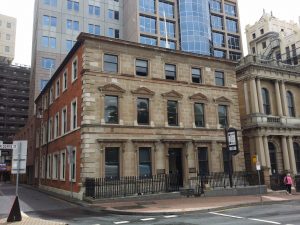
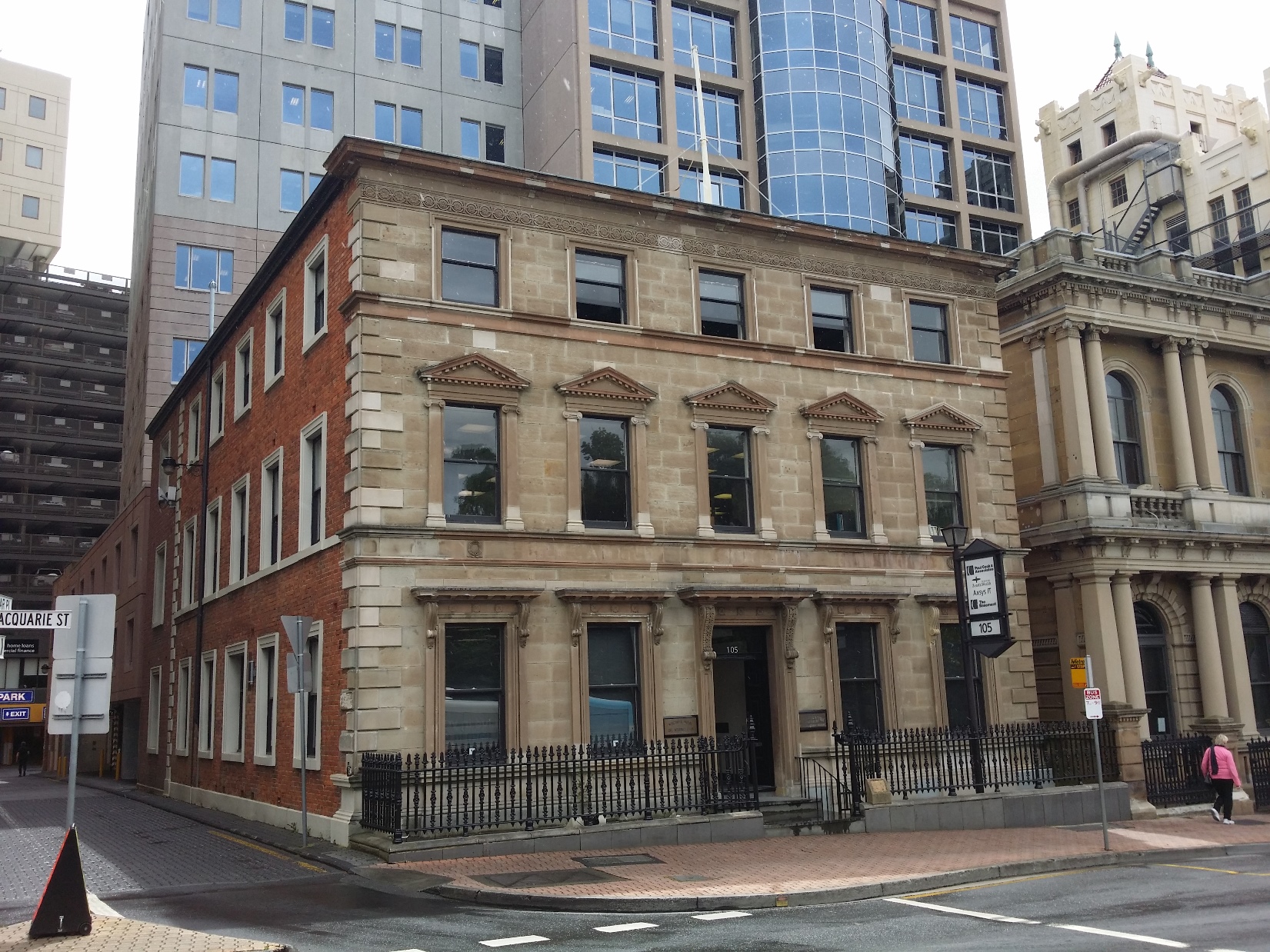
Office of the Comptroller General of Convicts, Josiah Spode, in 1855.
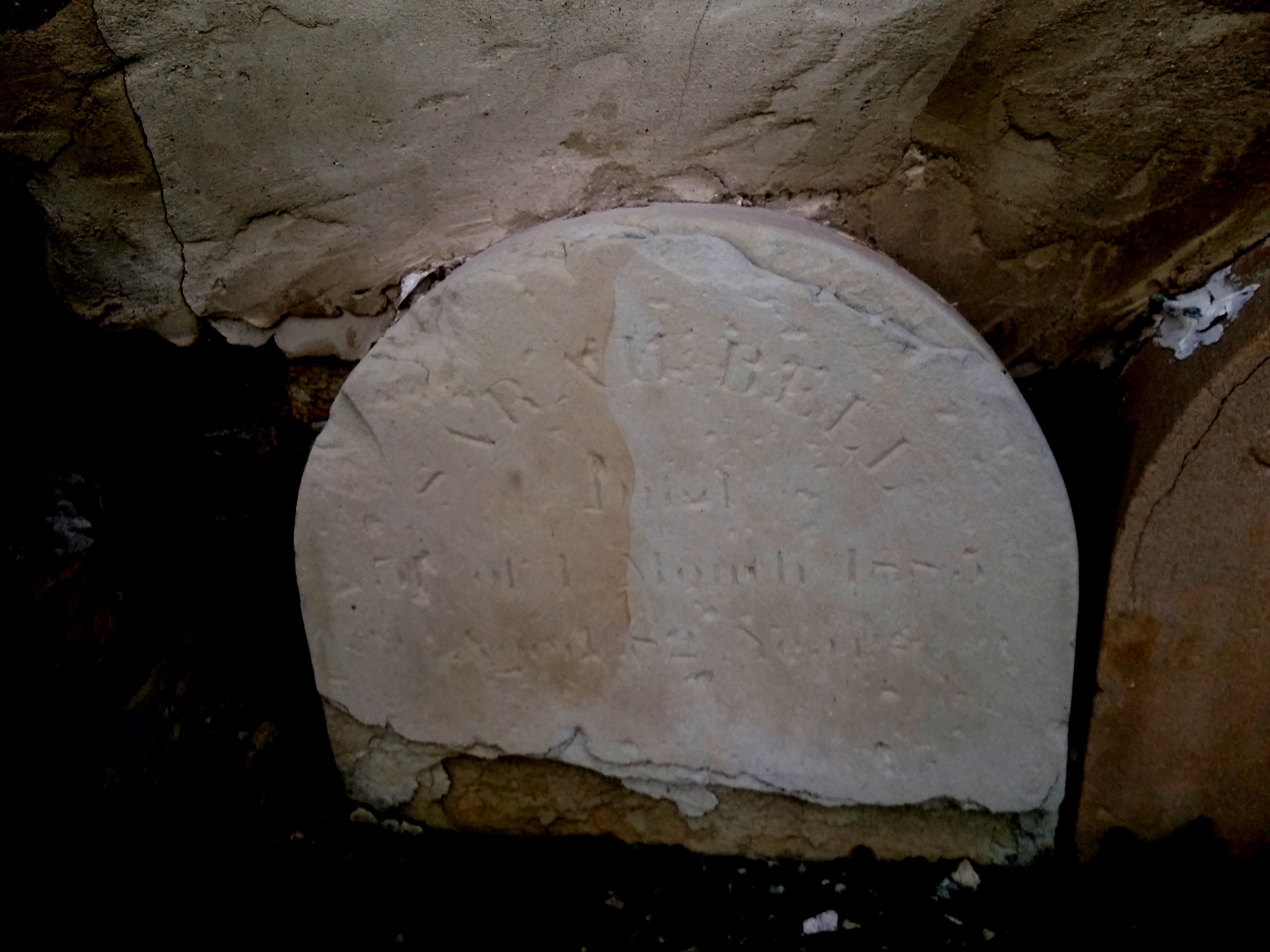
Sarah Bell, née Danby (1803–85), was born in London, England. After migrating to New South Wales, she married George Bell at Bullhill, near Liverpool, New South Wales, in 1834. The couple had three children—Sarah Jane (1836), Walter Stephen (1837) and Anne Danby (1839)—before relocating to Launceston, Van Diemen’s Land, in 1839 in order to operate a school. Anne Danby Bell died in Launceston in January 1840, but the couple had their youngest child, George Renison Bell, at Bothwell later that year. Sarah’s husband, George Bell, died in Hobart Town in 1852. In January 1855 her elder son, seventeen-year-old Walter, was sent to live at Port Arthur in hope of improving his health. Two months later Sarah decided to visit Comptroller General of Convicts, Josiah Spode, in his office in Macquarie Street, Hobart Town, to thank him for this kind action. Along her journey from West Hobart through the centre of town she was intimidated by campaigners for the simultaneous City of Hobart and Buckingham (Legislative Council) elections, won by Arthur Perry and William Crooke respectively.
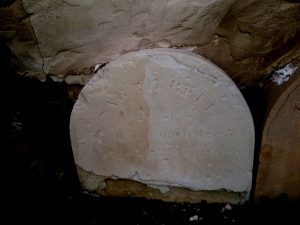
Headstone of Sarah Bell, Quaker Burial Ground, Hobart.
On the 7th I was enabled to go to town, the wind in the early part of the day being cool, but towards noon, it increased very much, & the dust began to fly about in every direction. I had to call on Mary Weeks our washer woman, who lives in Macquarie St, then upon my old friend Antonia Murdoch who to my sorrow was out; & lastly upon the Comptroller, to thank him for his kindness to my dear Walter. But long before I reached his office, I had to contend against a driving wind, & dust enough to blind any one: passing Arthur Perry’s office (who is one of the candidates for the city election) I had to encounter a mob of men, some of whom were holding flags & their speechifying, the German band playing, some apparently intoxicated, &c, &c. Oh dear thought I! What shall I do! It was folly to return, & confusion to go on, but still on, I went, & at last, reaching the Comptroller’s office, I rushed up the steps, thankful to get inside any dwelling wherein I might be permitted to shelter myself from the storm of the elements & of mankind. On enquiring of Murphy the office keeper if I could see the Comptroller?, he said, that the Private Secretary was with him just then; so of course there was no alternative, but that I must wait his departure, a privilege of which I was thankful to avail myself, as it would enable me to recover in some measure, from the flurry & disorder, into which I had been thrown by the aforesaid contending elements. So I sat down in the waiting room & commenced wiping my face & smoothing my ruffled plumage, so that I might appear somewhat decently before the Comptroller; during which time my ears were assailed with the discordant sounds of music, soft & gentle, & loud vociferating Hurrah’s [sic] for Perry, &c, &c accompanied with the punishing bass, of the triumphant gale, that was then blowing most furiously. Between 12 & one, midday, I was ushered into the presence of the Comptroller, he spoke very highly & kindly of my dear W assuring that his health had much improved & that he was carefully guarded by Mr & Mrs Boyd, he had appointed him a situation for two months (which was then vacant) desiring to help us all, but when that ended he hoped I should see my way clearly, respecting my son, as he cannot recommend his remaining in Govt employment; but still if we did see our way clear that he should so remain, he would appoint him a situation, with a house & a man servant, wood & water, rent free in which we could join him for all of which of course I felt truly thankful & expressed the same. Since then I have been very unwell. Arthur Perry & Dr Bedford contested for the city election & Dr Crooke & John Curwen Walker for the county of Buckingham. Perry has been chosen for the city, & Crooke for Buckingham. As a family we regret that Dr Bedford was not appointed for the city, & rejoice greatly for the success of Crooke …
by Nic Haygarth | 01/09/18 | George and Sarah Bell Quaker diaries
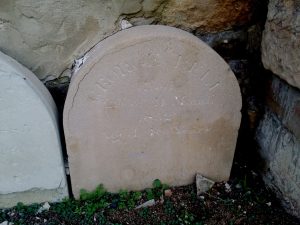
George Bell’s headstone, Quaker Burial Ground, Hobart
George Bell (1805–52) was born in Scotland and migrated to New South Wales on the barque Minerva in 1832, the voyage from Leith to Sydney lasting 5 months and 10 days, including a a stopover of more than three weeks in Hobart Town. Bell returned to live in Van Diemen’s Land with his new family in 1839.
George Bell diary Book 4
29/9/32 At 5 AM I got on deck & saw a range of rugged hills to the N with a large rock in the sea called the Mewstone some miles nearer us, but the weather prevented us making any progress during the day. On getting up the following morning we were off Tasman’s Head & entering Storm Bay with a fine breeze which left us as were abreast of Fluted Cape so called from its basaltic columns. By 11 the breeze freshened & we were passed Cape Fr Henry from whence we had a fine sail up to Hobart Town, during which I observed a man busy at his work mowing grass, so that I thought it no favorable [sic] specimen of the settlers observance of the Sabbath. After a voyage of 133 days from leaving Leith we cast anchor in Sullivan’s [sic] Cove, from which the town had a fine
p.153 appearance, & a small steamer passed us with passengers for the opposite shore of the Derwent. We brought the first intelligence of the passing of the Reform Bill to VD Land, I we had many visitants in the afternoon, mostly Scotchmen from one of whom Ballantyne of Glasgow I ascertained the circumstances of several individuals for whom I had letters, one of whom McLchose [sic] had lost all his goods recently in a vessel coming round from Launceston.
p.154 On 1/10/32 I first set foot on VD Land where I afterwards spent so many years. Having left the ship in company of Robertson the editor of “The Colonist” newspaper, he first took us to the Post office & then to his own house, where we had lunch. I had several parties to seek out & deliver letters & packets & messages to, from their friends & acquaintances in Scotland. Among others there were two females whom I had been accustomed to meet only in carpeted rooms, but their mothers death caused them to emigrate, & here in Hobart I found the eldest sitting as the mistress of a butcher’s stall, having married a butcher. The younger sister I met afterwards as a settlers [sic] wife in the country. Having found out a few other parties & dined at Robertson’s I went on board in the moonlight after spending a pleasant day. On the 3rd five of us crossed the river to Kangaroo Point, where we rambled in the bush, but saw only small birds to the disappointment of my comrades who had guns. I saw a
p.155 black snake coiled up at the foot of a tree, but hesitated to attack it till it saw me & made off. Having the loan of one of the guns I fired at a small bird & to my surprise I brot. it down, & found it of a yellowish tint. In our ramble we came to a cottage & the old man who lived in it showed us a hole in the wall which had been made the previous night while he was absent & the cottage robbed. I came upon another snake as I walked thro’ the bush & easily killed it with a stick. He was 3 ft 9 in long, of a yellowish color & of a poisonous species, with a black forked tongue. After a pleasant ramble, we dined in a tavern & got back to the ship before dark.
7th Several of us went ashore & attended the Burgher Meeting house & heard sermon from Macarthur on the Kingly character of Christ, but I was noways taken with the discourse. Some of our passengers having returned from New Norfolk, were delighted with the appearance of the country so that I arranged to set out on the 9th.
p.156 9/10/32 Soon after 7AM having got breakfast I started along with W Scott on the Launceston road, Hy Brock escorting us for a short distance. We found a good road & the country partially cultivated, with stone brick, & wooden houses at intervals till we reached a fine large stone house built for an Inn with a fine garden. This was Austin’s ferry & here we crossed the Derwent & which is here about ¾ mile broad. Being directed how to proceed we took our road thro’ the bush, but turned rather soon & came to a house & barns, about which we found no living creature so that we were quite at a loss. Going down a glen, we passed a cow & then a sawpit close to a small cave, until we were near the river. We then turned & going round the cultivated ground, rambled on in the heat of the day till it was past noon when we reached a wattle & daub cottage the door of which was opened by Amelia Beck, now Ross. She knew me at once she being sister to the butcher’s wife in Hobart & I was somewhat amused to see her walking in a pair of heavy shoes across
p.157 her mud floor which was not very even. Her husband a hale stout looking man about 40 soon came in from the ploughing & received us kindly. After dining on roast mutton &c Ross showed us over his farm He has 500 acres of his own 500 rented from a neighbour & 500 rented from Govt as a sheep run which he means to purchase. His farm is in a fine situation with a fine view from it a high picturesque basaltic rock called the Quoin forming a back fence to the land. On our return we had tea after which Amelia Ross played us a few tunes on her piano forte which she still retains. After a stroll in the moonlight & a chat by the fire, we retired to rest after walking about 20 miles in a fine warm day.
10th After an early breakfast we took leave of Amelia & her husband, & made our way back to the ferry, in crossing which we met a magistrate Gage who spoke well of Ross. Proceeding along the main road, at about 11 miles from Hobart we passed neat Barracks where a large chain gang are employed erecting a causeway
p.158 & bridge across the Derwent for the road to Launceston. Our road now lay along the bank of the river & we soon passed another gang who were burning lime. There were farms all along with inns at intervals. By 1PM we arrived at Elizabeth Town, where we enquired for the Bush Tavern, C Baker [Charles Barker] who seemed an agreeable smart young man. Here we remained for the night, walking in Baker’s fine garden & strolling thro’ the village which is mostly built of brick on a rising ground on the banks of the Derwent. The Lt Governor has a cottage in the vicinity & there is a church, jail, & hospital. Here we met with 2 of our shipmates who had started for Hamilton & got lost in the bush, which frightened them so that they come back as fast as they could, & made such a story of it that my companion took fright & said he would go no farther, at which I felt disappointed & annoyed, but I
p.159 was not easily turned from my purpose.
11th After a good nights rest we had breakfast & having settled the bill I took leave of my companion & by 9AM was put across the river in Baker’s boat when I took my road up towards Hamilton alone. I soon met a cart filled with skins of Kangaroo &c, drawn by six oxen going to market with a woman on the top, who said she was from Glasgow. Found houses all along with farms & gardens, which gave the country a pleasant appearance. I was hailed by an old man in the yellow garb of a convict, who took me for a constable & told me there was a bushranger hereabouts. This man had been in the 92d regt & all he had now to do was to supply a baker with firewood for his oven. Soon after noon I reached the Wool Pack Inn where I had some wine & rested till 1PM when I started for Downie’s. I soon reached fine
p.160 grass covered hills on which no trees had grown & continued my walk till I met an old shepherd T Burns who showed me Downie’s huts where I found the cook who supplied me with boiled mutton &c on which I dined. The cook having cleaned himself accompanied me across the country & we killed a snake 21 in in length. Crossing marshes & brooks, & pursuing our path along the side of hills thro’ trees till we came down to Wm Clelands by 4PM. Here his cook made tea for us & his master came home about 6 o’k when I went & met him with letter from his brother. He recognized my face & made many enquiries about old acquaintances. His calls his station Thornhill, being in the district of Macquarie Plains. The hut is of upright slabs with wide seams between, partly stuffed with wool. We retired to rest on wooden sofas covered with a mattrass [sic], & after about 20 miles walk I enjoyed a good nights rest.
p.161 12/10/32 After having bfast we were detained by rain till after 10 o’k when Cleland & I started with 3 Kangaroo dogs but unfortunately the spaniel followed us & by barking prevented our catching anything. C led the way thro’ the scrub on the lower part of the hills where the dogs started several Kangaroos one of which passed near me & I also had a view of a kangaroo rat running along. By 1PM we arrived at a stone cottage where Steel keeps an Overseer & some men. Here we dined on mutton &c with boiled flour pudding called ‘doeboy’. Saw the sinews drawn from the tails of two kangaroos which had been recently killed & they were presented to me. When thread was scarce, they have been used for sewing as well as for fiddle strings & other purposes. We then crossed a fine grass country to Downies who was gone to get his plough share repaired, so we followed on to the Woolpack Inn & here we found Downie sitting with the host
p.162 & his wife. D ordered dinner for me & after that they began to play cards which I took no part in, but occupied myself in reading an old No. of the Quarterly Review. They went on till 10.30 when they left, desiring me to go with them, but I preferred remaining where I was after walking about 20 miles. Downie has 1000 acres of land & about 7000 sheep, renting 7000 acres from Col Sorell for £350 a year.
13/10/32 After a sound sleep & a good bfast I found my cash was short, so I had to tell my landlady how it was. She said it did not matter but took the 4/4 dollar for the 6/-. 8.20 Started in a wet morning with my umbrella over me. The road was very deep in many places & the rain kept on till I was almost at Elizab town where I had to hallo to the ferry & get over, when I told Baker how it was with me & he made me welcome to the ferry. Called at Robertson’s & got a tea dinner but did not see him (Hector) as he was out Start again 1.20 & found the road pretty good so that I entered Hobart by 7 just as it is was dark. Called on one of our passengers & got tea
p.163 Met our Dr & went to the wharf with him & at 9 we got a boat to put us on board where I went to bed after a walk of 36 miles, finding a blister on one foot but I was much pleased with my trip on the whole.
14/10/32 Remained on board today & the Sarah brig arrived from Liverpool with passengers. I visited her on the 15th but made no stay. Took up this day mostly in writing & in the evening had another drunken squabble with old Cadell, but I was enabled to keep out of it. The following evening 16th he abused me when he was drunk, but I paid no attention to it. 17th We saw two men hanged on the gallows, from the ship, & I was shewn ‘The Times’ of yesterday containing the testimonial of the Passengers to the Capt’s good conduct.
18th Went ashore with Moat & walked thro’ the Paddock till we came to the Govt garden where we enquired for the Supt Davidson but he had gone to town however we were told to walk in which we did. It is situated on the banks of the Derwent & looks very well, altho’
p.164 not so nice as I should wish. There is an Eagle chained & 3 hives of bees, which are thriving well since imported. Adjoining the gardens we saw a pr of Pheasants, Kangaroos, Rabbits, a native Cat & a Devil as it is termed, also a black & blue bird, the size of a hen, which they styled a Balcoot. Leaving the garden we took our way over the hill to New Town where we saw a very pretty place of Owen’s a Magistrate. Passed a Haystack being the first I have seen. Reached the main road to Launceston & a little beyond the 3rd milestone we came to a white cottage where we found Fr Argo & his wife who made tea for us. He has got his forge nearly finished. Returned to town at the Fairbairns & called on TG Smith who shewed me his library.
p.165 My friend Cleland paid me a visit on the 20th & on the following day we were fairly under weigh for Sydney with a favorable [sic] breeze, passing Cape Pillar, so called from a pillar shaped rock, & the whole coast here has a singular appearance from is basaltic formation. Our ship made so much water than on the 23rd the Pump required to be worked every hour, but they afterwards managed to partly stop the leak so that we made less water. 22d We were in with the coast, very high land; & on 23d we were in sight of a high mountainous coast with flocks of a small black bird flying about. On the even of the 25th it began to blow & we had sight of the stormy Petrel for the first time since leaving the north seas. On the forenoon of the 27th I went up the main mast & touched the truck of the royal mast, a fate I had determined to accomplish if possible, but for which I was reproved, as being too rash in my case. [in the margin: ‘20/3/52’ (sic)]
by Nic Haygarth | 28/10/17 | Tasmanian high country history
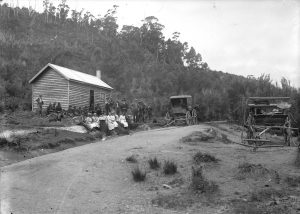
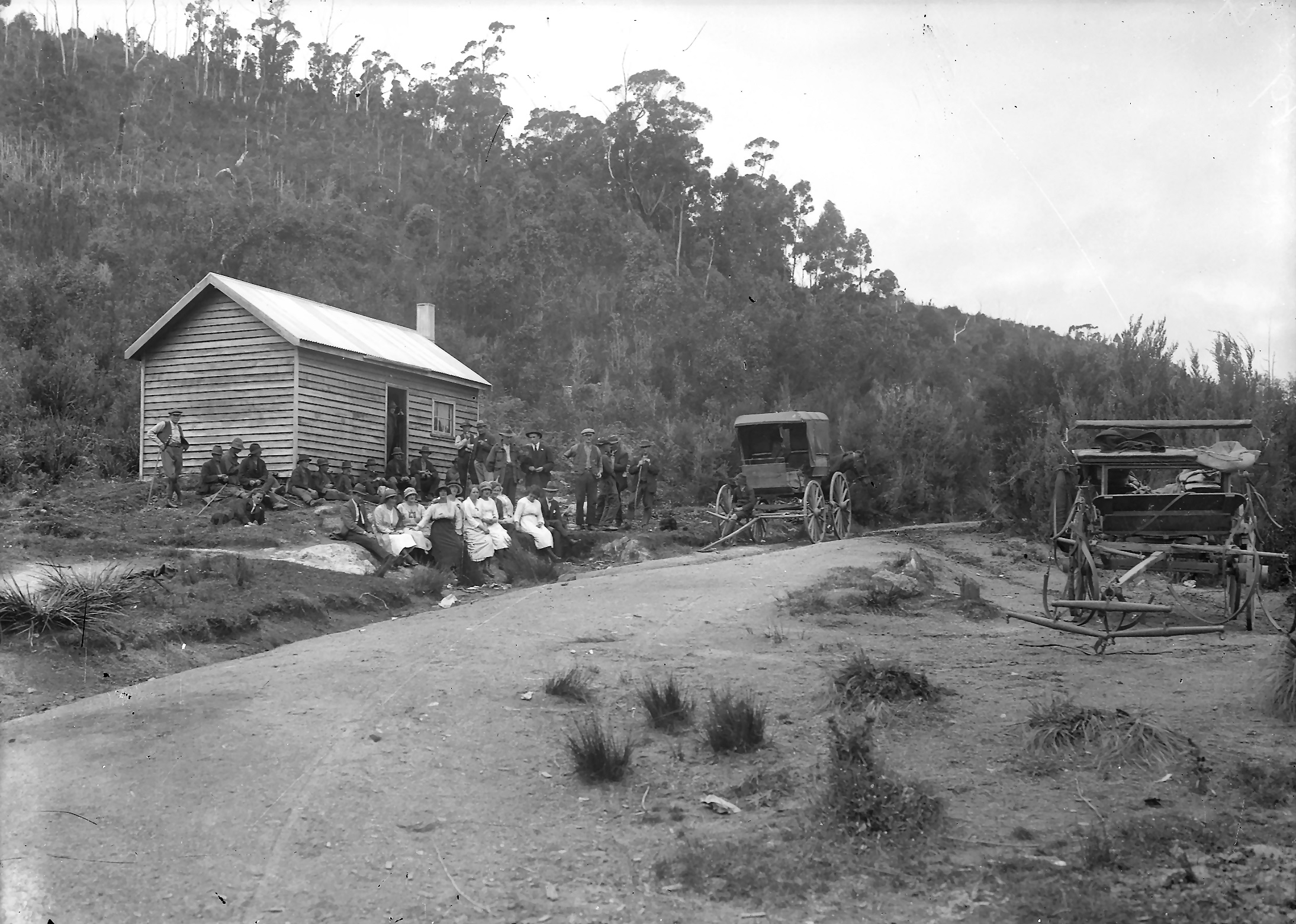
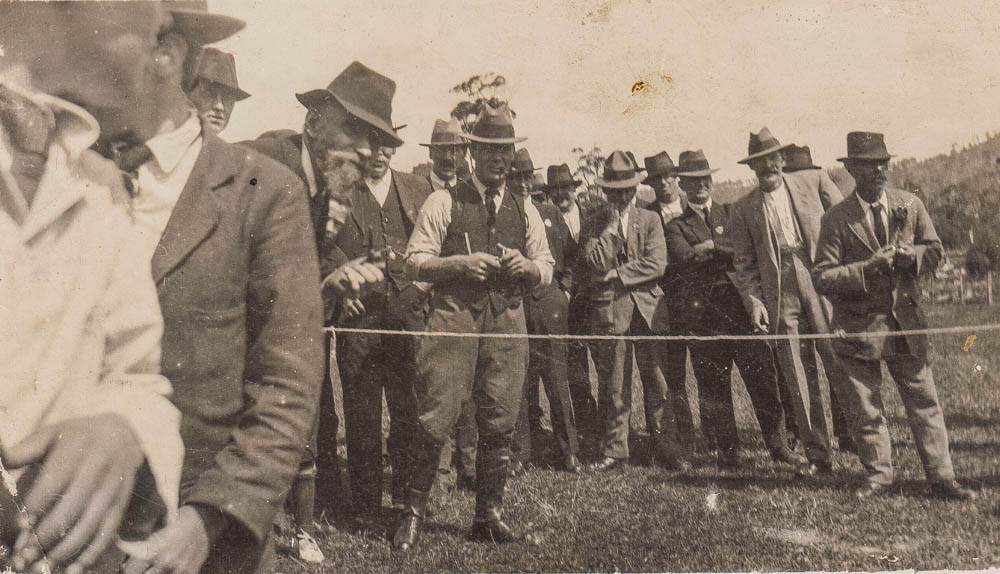
Osmiridium diggers meeting their wives and receiving their stores at the Nineteen Mile Hut, probably in 1921. JH Robinson photo from the Colin Dennison Collection, University of Tasmania Archives.
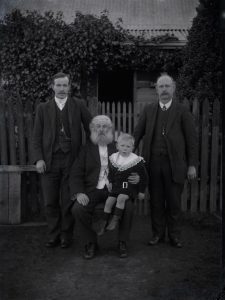
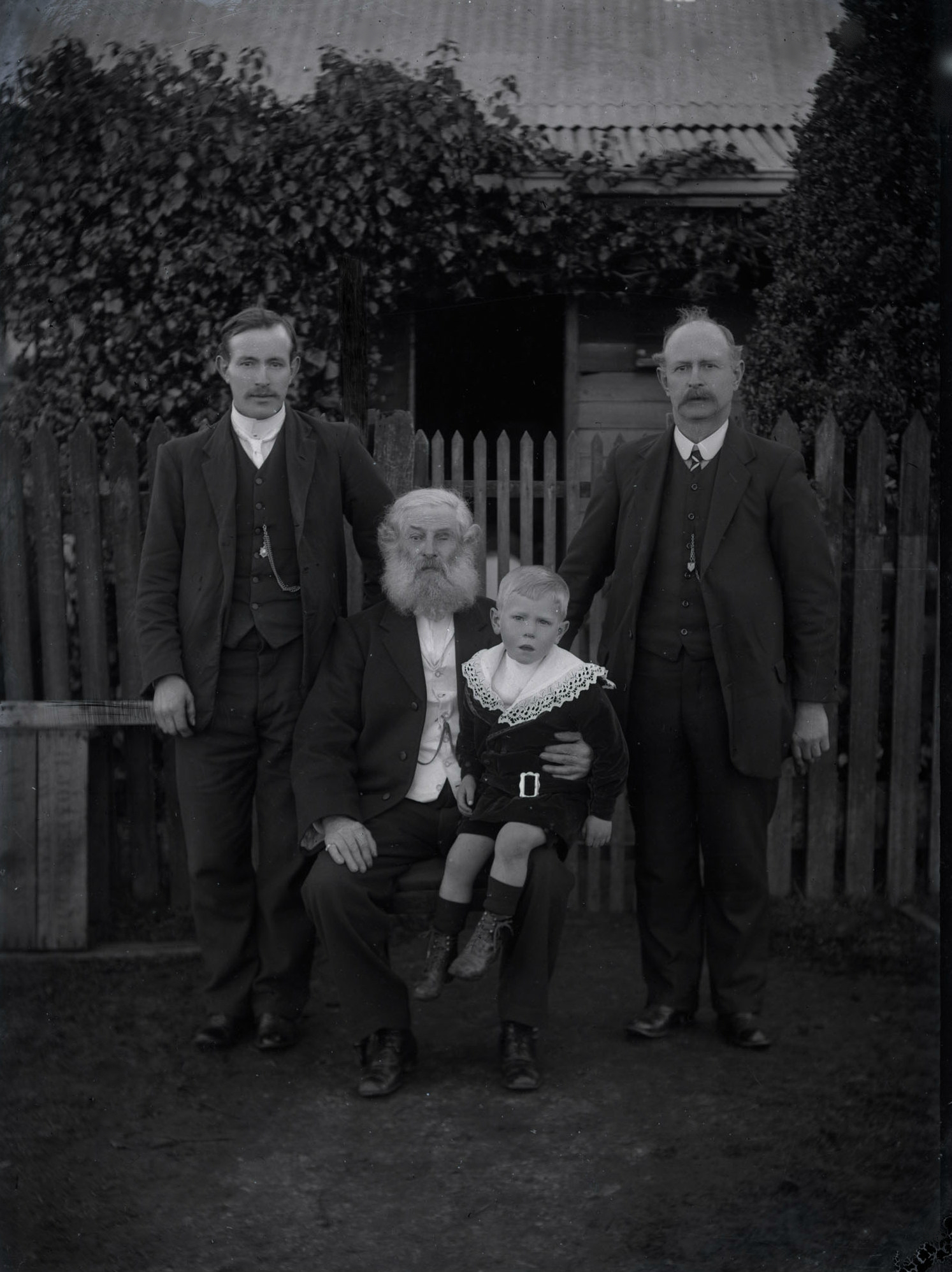
Four generations of Waratah’s Thorne family, including osmiridium miner and buyer JH Thorne at right. JH Robinson photo courtesy of the late Nancy Gillard.
The diggers were grizzling. In 1921 Tasmania enjoyed a world monopoly on ‘point metal’ osmiridium, that is, osmiridium grains that were just the right size to fuse onto the nibs of gold fountain pens. The ossie price was generally high. Tasmania’s niche in the market was unchallenged. The diggers on the fields west and south-west of Waratah should have been happy.
They weren’t. Part of the problem was that few had a grasp of economics. They did not understand that they dampened demand by rushing their ore to market. Remotely located diggers working alone felt cut off from the metal market. Some were convinced that they were the victims of collusion between precious metal buyers who were determined to force down the price.
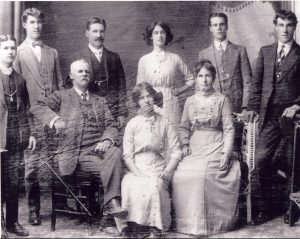
Secretary of the osmiridium pool, Chris Sheedy, is third from left at back. Second from left in the front row is Chris Sheedy senior, onetime foreman of the Brown Face at the Bischoff mine. Photo courtesy of John Turnbull.
Calls for government to intervene in the market were finally answered when Premier Sir Walter Lee agreed to introduce an experimental monopoly. As of 1 January 1922, precious metals dealer Overell & Sampson held the only Tasmanian osmiridium buyer’s licence—so now there could be no collusion. Could the company get the diggers a better price for their metal? Almost 250 men banked on it, selling their osmiridium through the government scheme. The list of sellers compiled on 30 June 1922 is now a handy checklist for historians and genealogists. Here are the men in one long list by rough alphabetical order as set out in the government records.[1] My only addition is some comments in the column at right.
| Name |
Value of os (£, s & d) |
Weight of os (oz, dwts & grains) |
Comments |
| Anderson, Thomas |
35-15-7 |
2-3-9 |
|
| Aylett, George |
40-11-3 |
2-7-5 |
|
| Aylett, William |
85-9-8 |
5-0-12 |
Later at Adamsfield |
| Allan, G & W |
97-10-7 |
5-10-1 |
|
| Allan, BJ |
40-10-0 |
2-0-12 |
|
| Allan, J |
40-0-0 |
2-0-0 |
Jim Allan, Nineteen Mile Creek |
| Baptist, J |
50-0-0 |
3-14-21 |
John D’Ahren Baptiste, aka Hooky Jack, later at Adamsfield. |
| Baptist, J (Reserve) |
100-5-0 |
5-0-6 |
|
| Beale, W |
30-6-6 |
1-14-8 |
|
| Berryman, E |
133-7-10 |
8-18-17 |
|
| Berkery, M |
27-18-7 |
1-12-0 |
|
| Buckingham, H |
11-3-3 |
0-11-20 |
|
| Betts, WA |
46-14-4 |
3-1-23 |
Betts Track named after a Betts prospector. |
| Biggins, Norman |
26-5-0 |
1-15-0 |
|
| Billinghurst, J |
20-11-0 |
1-3-16 |
|
| Booth, George |
31-18-9 |
2-2-14 |
|
| Booth, William |
45-2-5 |
2-17-4 |
|
| Boyd, H |
53-6-0 |
3-5-11 |
|
| Brown, G |
20-0-0 |
1-19-21 |
|
| Bryant, JH |
71-8-9 |
4-13-14 |
Former Derby shopkeeper. Committee member of the osmiridium pool. |
| Burness, J |
16-15-0 |
1-2-8 |
|
| Burness, Charles |
18-5-0 |
1-4-8 |
|
| Brettoner, JE |
18-5-0 |
1-4-8 |
|
| Blake, UJ |
12-12-3 |
0-16-3 |
|
| Bosich, L |
13-15-0 |
0-18-8 |
|
| Brodie, W |
1-11-8 |
0-1-14 |
|
| Button, A |
47-19-5 |
2-9-18 |
|
| Booth, George Jnr |
32-9-2 |
1-12-11 |
|
| Burge, J |
11-14-2 |
0-11-17 |
|
| Burke, RH |
2-11-0 |
0-3-0 |
|
| Bynon, R |
42-11-3 |
2-5-17 |
|
| Blair, F |
8-0-0 |
0-8-0 |
|
| Burness, HB |
21-5-0 |
— |
|
| Callaghan, B |
75-13-6 |
4-10-12 |
|
| Carpenter, T |
53-18-4 |
3-6-18 |
|
| Carmody, H |
37-0-0 |
4-0-0 |
|
| Clementson, M |
13-3-5 |
1-3-15 |
Matty Clementson, ‘the [Mount] Stewart king’. |
| Coghlan, J |
17-0-0 |
0-17-0 |
|
| Crawford, T |
53-0-7 |
5-10-5 |
|
| Casey, W |
75-0-7 |
4-0-13 |
|
| Casey, W |
43-14-11 |
2-18-8 |
|
| Cashman, John |
39-18-2 |
2-9-15 |
|
| Caudry, William |
15-0-0 |
1-0-0 |
Caudry’s Reward reef mine, Caudrys Hill, the first mine of its kind in the world. Also had a lease at Mount Stewart. |
| Caudry, William |
100-0-0 |
5-0-0 |
|
| Caudry, Thomas |
62-17-6 |
3-2-21 |
Brother of William Caudry. |
| Cooney, J |
45-17-6 |
2-5-21 |
|
| Cumming, R |
47-19-7 |
2-9-18 |
|
| Chellis, WH |
128-11-8 |
6-8-14 |
Walter Chellis, Castray River, champion axeman & publican. |
| Cook, Henry |
48-13-10 |
2-18-2 |
|
| Cady, W |
31-7-8 |
1-16-22 |
|
| Davidson, J |
19-0-7 |
1-2-3 |
Jack Davidson, stalwart of the Nineteen Mile. |
| Devlyn, Fred |
73-9-6 |
4-0-3 |
|
| Devereaux, H |
28-9-7 |
1-12-3 |
|
| Dixon, J |
49-4-7 |
2-15-15 |
|
| Doak, William |
5-18-9 |
0-7-23 |
Doaks Creek at Adamsfield named after him. |
| Doran, William |
47-14-7 |
3-0-7 |
|
| Donovan, D |
42-0-0 |
2-6-0 |
|
| Dhu, Hugh |
47-2-4 |
2-14-20 |
|
| Dunn, Steve |
34-8-6 |
2-0-12 |
|
| Drew, M |
21-11-7 |
1-5-16 |
|
| Duffy, James & Manion, Thomas |
— |
1-2-0 |
|
| Devlyn, John |
6-5-7 |
0-8-9 |
|
| Dixon, TF |
12-13-2 |
0-16-8 |
|
| Dwyer, S |
42-11-10 |
2-13-4 |
Sammy Dwyer, from NSW, last man at the Nineteen Mile, 1950s |
| Duffy, J |
27-4-2 |
1-14-23 |
|
| Dunn, John |
23-13-4 |
1-3-16 |
|
| Donohue, J |
18-16-0 |
1-0-6 |
|
| Davies, D |
20-6-6 |
1-2-3 |
|
| Dickson, C |
42-10-7 |
2-5-16 |
|
| Davie, A |
48-10-0 |
2-10-0 |
Probably Arthur Davey, one of the stalwarts of the Nineteen Mile. |
| Dettoner, AC |
11-12-4 |
0-11-16 |
|
| Davies, C |
25-0-0 |
1-5-0 |
|
| East, G |
61-16-8 |
5-5-20 |
|
| Easther, C & Garrett, T |
100-4-2 |
5-0-5 |
|
| Easther, C |
52-4-7 |
4-16-8 |
|
| Eastwood, William |
38-16-8 |
2-13-2 |
|
| Elmer, William |
57-19-1 |
4-6-9 |
|
| Ellims, V |
79-19-0 |
4-11-18 |
|
| Evans, Charles |
58-10-7 |
3-8-3 |
‘Chillie’ Evans, a well-known digger. |
| Eames, G |
71-10-7 |
4-0-15 |
Jones Creek digger George Eames, whose dealings with osmiridium buyer Robert Krebs in 1923 helped bring down the government monopoly scheme. |
| Etchell, Thomas |
18-16-3 |
1-4-10 |
Brother of well-known bushman, Luke Etchell, with whom he lived at Guildford. They were also pulp wood cutters and snarers. |
| Fenton, S |
58-18-1 |
3-6-23 |
|
| Ferguson, WJ |
18-5-5 |
3-4-6 |
|
| Flowers, S |
31-17-0 |
3-5-19 |
|
| Forbes, A |
47-5-0 |
6-3-0 |
|
| Finlay, R |
50-19-10 |
2-12-7 |
|
| Fenton, AW |
43-2-6 |
2-13-13 |
|
| Ferrari, S |
99-3-11 |
5-5-8 |
|
| Frazer, JD |
10-8-3 |
0-11-21 |
John D ‘Scotty’ Frazer, a well-known digger who disappeared in the bush in 1923, thought to have drowned. |
| Findon, John |
14-0-0 |
0-14-0 |
|
| Fahey, James |
69-8-4 |
4-0-17 |
|
| Farquhar, John |
27-4-8 |
1-8-8 |
|
| Flight, W |
12-18-6 |
0-15-5 |
|
| Finlay, JH |
1-18-4 |
0-1-22 |
Jack Finlay, remembered by osmiridium fields poet Mulga Mick O’Reilly as ‘Jack Fennelly’. |
| Garratt, T |
52-4-7 |
4-16-8 |
Probably Tyson Garrett of Savage River. |
| Grant, William |
19-9-1 |
1-3-6 |
|
| Grant, Charles |
43-10-6 |
2-8-12 |
|
| Grills, H |
51-15-8 |
3-19-4 |
|
| Grosser, PA |
79-11-0 |
4-15-0 |
Magnet’s Phil Grosser, of Mount Stewart and the Nineteen Mile, later at Adamsfield. |
| Grubb, John |
18-16-4 |
1-0-9 |
|
| Gould, J |
21-1-2 |
1-2-17 |
|
| Gatehouse, H |
79-11-8 |
3-19-14 |
|
| Gurney, C |
3-3-0 |
0-3-17 |
|
| Harper, Thomas |
25-8-8 |
1-9-3 |
|
| Hamilton, William |
21-7-6 |
1-11-17 |
|
| Harrison, J |
25-0-0 |
4-16-3 |
Is this Wynyard’s James ‘Tiger Cat’ Harrison, real estate agent, ‘human cork’ and prospector, who dealt in live marsupials, including thylacines? |
| Henderson, C |
14-11-10 |
0-18-18 |
|
| Hines, William J |
— |
0-12-7 |
|
| Hodson, H |
17-3-3 |
1-1-5 |
|
| Hughes, Victor |
24-14-9 |
3-8-5 |
|
| Humphries, Albert |
43-12-3 |
2-11-16 |
|
| Humphries, Albert |
36-6-10 |
1-19-12 |
|
| Humphries, R |
52-0-10 |
3-6-1 |
Probably Magnet resident Robert Humphries, of the Mount Stewart field. |
| Hancock, J |
31-13-10 |
2-0-5 |
Probably Jos Hancock, of Flea Flat, Nineteen Mile Creek, whose hut was used as a location in the movie Jewelled Nights in 1925. |
| Hanlon, T |
93-8-3 |
5-5-22 |
|
| Harvey, Joseph |
72-17-7 |
4-9-0 |
|
| Humphries, HH |
34-18-4 |
1-14-22 |
|
| Harrison, M |
32-0-0 |
1-12-0 |
|
| Hope, A |
22-1-8 |
1-2-2 |
|
| Hollow, J |
43-4-2 |
2-3-5 |
|
| Hill, Kenneth |
19-8-0 |
1-3-10 |
|
| Inglis, AL |
33-6-8 |
1-13-8 |
|
| Inglis, AL |
208-0-0 |
10-0-0 |
|
| Jones, RW |
100-0-0 |
10-0-0 |
Probably Robert Walter Jones, aka Wally Jones, who later went to Adamsfield and was osmiridium buyer HB Selby & Co’s agent there. |
| Jones, CH |
22-14-4 |
1-10-7 |
|
| Jans, FC |
77-6-5 |
4-6-0 |
Fred Jans, later at Adamsfield, where he died in 1944. |
| Johnston, L |
31-15-0 |
1-11-18 |
|
| Jones, TH |
60-0-0 |
3-0-0 |
Possibly Tom Jones, after whom Jones Creek was named. |
| Jones, John |
16-0-1 |
0-17-16 |
|
| Jenner, H |
8-5-6 |
0-8-12 |
Harry Jenner, later at Adamsfield. |
| Keltie, William |
18-3-11 |
1-2-23 |
|
| Kenny, J |
57-17-6 |
4-7-9 |
|
| Kinsella, A |
39-2-8 |
2-8-21 |
Possibly related to Bill Kinsella of Wilson River. |
| Kelcher, John |
38-9-11 |
2-10-2 |
|
| Knight, W |
16-18-7 |
0-19-22 |
|
| Kelly, James |
16-18-5 |
1-2-13 |
|
| Keenan, C |
22-16-8 |
1-2-20 |
|
| Kershaw, F |
11-19-5 |
0-14-2 |
|
| Lane, R |
31-14-4 |
1-15-15 |
Roger Lane, who worked with the Maywood brothers at the Nineteen Mile. |
| Leary, M |
34-6-3 |
2-11-14 |
|
| Long, Thomas |
32-3-11 |
2-0-7 |
|
| Long, Thomas |
27-3-10 |
1-8-7 |
|
| Leach, George |
10-1-10 |
0-11-21 |
|
| Loughnan, E Jnr |
50-15-7 |
3-6-17 |
‘Peg Leg Ted’, one of the discoverers of payable osmiridium at Mount Stewart. Had a prosthetic leg. Loughnan Creek is named after him. |
| Loughnan, James |
54-3-5 |
3-8-10 |
|
| Lyons, T |
3-15-0 |
0-5-0 |
|
| Loughnan, E Snr |
42-16-3 |
2-17-2 |
|
| Llewellyn, John |
47-0-0 |
2-15-0 |
|
| Loughnan, George |
51-5-11 |
2-14-18 |
|
| Mackersey, L |
24-1-8 |
1-18-0 |
|
| Maywood, A |
32-14-2 |
2-9-13 |
Brother of Ted Maywood, with whom he worked at the Nineteen Mile, along with Roger Lane. |
| Maywood, E |
16-10-0 |
1-10-11 |
Ted Maywood, who worked at the Nineteen Mile with his brother and Roger Lane. |
| Mills, James & Jenner, H |
— |
1-3-4 |
|
| Mills, J |
57-16-3 |
4-15-18 |
|
| Mills, J |
19-2-6 |
1-2-12 |
|
| Moore, A |
28-16-8 |
3-14-5 |
Probably Savage River digger Albert Moore, brother of Reuben Moore. |
| Morgan, William |
87-8-0 |
5-11-12 |
|
| Moore, RR |
74-3-9 |
4-3-17 |
Probably osmiridium digger and buyer Reuben Moore, who died at Savage River in 1925. |
| Moffitt, LJ |
53-15-10 |
2-13-19 |
|
| Martin, J |
6-0-0 |
0-6-0 |
|
| Manion, Thomas |
26-4-2 |
1-12-23 |
From the Beaconsfield family of Manions? |
| Mallinson, RD |
17-0-0 |
0-17-0 |
|
| Meares, RK |
11-11-7 |
0-13-15 |
|
| Matthews, T |
15-0-4 |
0-17-16 |
Possibly ‘Winger’ Matthews, who appeared in Marie Bjelke Petersen’s novel Jewelled nights as ‘Wingy’ Matthews. |
| Major, J |
85-2-10 |
5-0-4 |
|
| McAvoy, D |
82-1-11 |
5-19-1 |
|
| McAidell & Hill |
|
|
Probably CL McArdell and Harry Hill, the latter being a well-known digger who was later at Adamsfield. |
| McCaughey, LB |
37-3-1 |
2-4-20 |
|
| McDiamid, William |
— |
0-10-0 |
|
| McGuiness, A |
32-2-9 |
1-18-19 |
|
| McGuire, J |
44-18-9 |
3-14-12 |
|
| McCormack, Charles |
33-5-0 |
2-4-8 |
|
| McGuiness, F |
28-4-1 |
1-10-21 |
|
| McCaughey, M |
43-14-4 |
2-8-6 |
|
| McCaughey, William |
15-14-9 |
0-16-14 |
|
| McQueeny, F |
11-14-2 |
0-11-17 |
|
| McArdell, CL |
30-19-9 |
1-16-11 |
|
| McDonald, Alex |
8-10-0 |
0-10-0 |
Of Flea Flat, Nineteen Mile Creek, where he shared a hut with Jim McGinty until the latter’s death in 1920. |
| Newman, M |
21-15-9 |
1-5-9 |
|
| Newman, M |
37-18-7 |
2-4-15 |
|
| Nelson, H |
40-0-0 |
2-0-0 |
|
| Osborn, WH |
44-4-3 |
2-13-10 |
|
| Oakley, H |
21-16-4 |
1-8-1 |
|
| Oakley, J |
38-5-11 |
2-12-4 |
|
| Oakley, H & Loughnan, J |
7-10-0 |
0-10-0 |
|
| Oakley, RP |
9-18-1 |
0-13-5 |
|
| Papworth, S |
40-0-0 |
4-0-0 |
Later of Adamsfield. |
| Pearson, Robert |
103-15-8 |
6-0-6 |
|
| Prouse, Charles A |
141-8-0 |
8-9-10 |
Charles Arthur Prouse, son of Tom Prouse. Together in 1922 they were pictured with two large nuggets found on the upper Nineteen Mile, the one found on the dump by his father being a record 4.5 oz. Charlie Prouse later went on to Adamsfield, where he was the first bride groom on the field, marrying the bush nurse, Constance Brownfield, in 1928. Also an osmiridium buyer at Adamsfield. |
| Prouse, William |
67-9-5 |
3-12-10 |
|
| Parsons, Norman |
35-12-6 |
2-7-12 |
From Caveside, was part of the syndicate trying to work a hydraulic show at the Little Wilson River. |
| Prouse, J |
78-16-7 |
4-5-8 |
|
| Paine, Hy |
16-18-5 |
1-2-14 |
Possibly Harry Reginald Paine, later the author of a book about Waratah, Taking you back down the track … |
| Paine, W |
18-8-4 |
0-18-10 |
|
| Power, T |
18-10-0 |
0-18-12 |
|
| Prouse, H |
20-4-0 |
1-2-14 |
|
| Paine, Thomas |
51-7-6 |
2-11-9 |
|
| Reimers, J |
36-5-0 |
3-3-6 |
|
| Richardson, A |
47-15-0 |
4-2-3 |
|
| Richards, J |
48-10-10 |
4-12-22 |
|
| Ruggeri, R |
27-12-8 |
1-12-13 |
|
| Russell, J & Casey, W |
— |
2-6-12 |
|
| Russell, J |
67-5-7 |
3-12-19 |
Osmiridium pool committee member. |
| Russell, J |
43-14-4 |
2-18-7 |
|
| Ramsay, James |
62-17-6 |
3-2-21 |
|
| Ruffin, H |
36-10-0 |
1-16-12 |
|
| Rearden, S |
6-18-1 |
0-8-3 |
Syd Reardon, from Lorinna, alcoholic prospector. |
| Schill, F |
— |
1-7-0 |
|
| Shea, M |
79-16-8 |
4-9-20 |
|
| Sheedy, Chris |
39-15-9 |
4-7-4 |
Secretary of the osmiridium pool. |
| Sims, W |
12-14-7 |
1-6-1 |
|
| Simpson, PC |
34-5-6 |
1-17-21 |
|
| Stanley, H |
58-11-1 |
3-13-20 |
|
| Smith, WH |
34-0-0 |
2-0-0 |
|
| Smith, R |
70-0-5 |
4-17-22 |
|
| Spencer, T |
81-2-6 |
7-1-3 |
|
| Sutton, WH |
7-17-6 |
0-10-12 |
|
| Stanton, JM |
65-10-11 |
3-16-19 |
Reward lease holder (with Edward Loughnan jnr) at Mount Stewart. |
| Symons, GC |
15-0-0 |
1-0-0 |
|
| Spencer, John |
88-8-1 |
5-6-18 |
|
| Stebbings, A |
74-6-8 |
4-6-13 |
|
| Shady, William |
30-5-0 |
2-0-8 |
William Antonio Shady, son of Syrian hawker and shopkeeper Antonio Shady, osmiridium buyer. Became a Waratah storekeeper. |
| Smith, Martin |
38-7-11 |
2-6-1 |
|
| Sullivan, J |
36-1-4 |
2-1-11 |
|
| Symons, James B |
45-18-4 |
2-11-22 |
|
| Symons, James B |
105-0-0 |
7-0-0 |
|
| Shaw, Thomas |
114-2-2 |
6-13-17 |
|
| Sewell, J |
8-2-6 |
0-8-3 |
|
| Spencer, James |
25-7-6 |
1-5-9 |
|
| Symons, Charles & George |
154-10-0 |
7-14-12 |
|
| Scoles, J |
6-8-11 |
0-7-14 |
|
| Symons, Charles |
81-5-7 |
4-15-15 |
|
| Thomas, T |
15-7-5 |
0-18-2 |
|
| Thurstans, F |
61-14-3 |
4-10-15 |
|
| Thorne, A |
66-7-9 |
5-6-4 |
|
| Thorne, Charles |
95-4-11 |
5-10-20 |
|
| Thorne, W |
33-6-9 |
2-3-4 |
|
| Tudor, Lionel |
91-4-8 |
6-18-3 |
|
| Tudor, Lionel |
110-5-0 |
7-7-0 |
|
| Tunbridge, E |
39-3-9 |
2-17-6 |
|
| Turner, H |
— |
1-12-11 |
|
| Taylor, James |
18-5-0 |
1-4-8 |
|
| Tudor, Henry |
111-2-2 |
6-2-8 |
|
| Thorne, Harold |
12-12-8 |
0-14-13 |
|
| Thorne, H & W |
44-5-0 |
2-8-12 |
|
| Venville, D |
36-19-2 |
2-7-12 |
|
| Watkins, J |
24-15-7 |
1-8-6 |
|
| Wilson, R |
54-0-0 |
4-0-12 |
|
| Wilson, W |
37-17-6 |
2-10-12 |
|
| Whyman, Victor |
59-12-1 |
3-14-22 |
Driver for his brother Ray Whyman, storesman and packer on the osmiridium fields. Claimed to be the model for the singing driver in Marie Bjelke Petersen’s novel Jewelled nights. |
| Whyman, Arthur |
30-11-3 |
2-0-18 |
|
| Whyman, Phillip |
52-6-8 |
2-17-8 |
Proprietor of the Bischoff Hotel. |
| Wilson, J |
35-8-3 |
2-1-12 |
|
| Wilson, Percy W |
34-18-1 |
2-3-21 |
|
| Woolley, James |
4-12-1 |
0-5-9 |
|
| Walters, WA |
25-8-4 |
1-5-10 |
|
| Wragg, H |
12-10-0 |
0-12-12 |
|
[1] From AB948/1/98 (Tasmanian Archive and Heritage Office).
by Nic Haygarth | 11/08/17 | Tasmanian high country history, Tasmanian nature tourism history
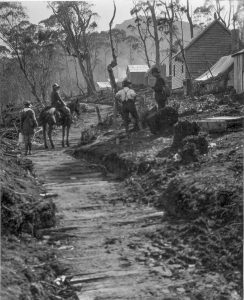
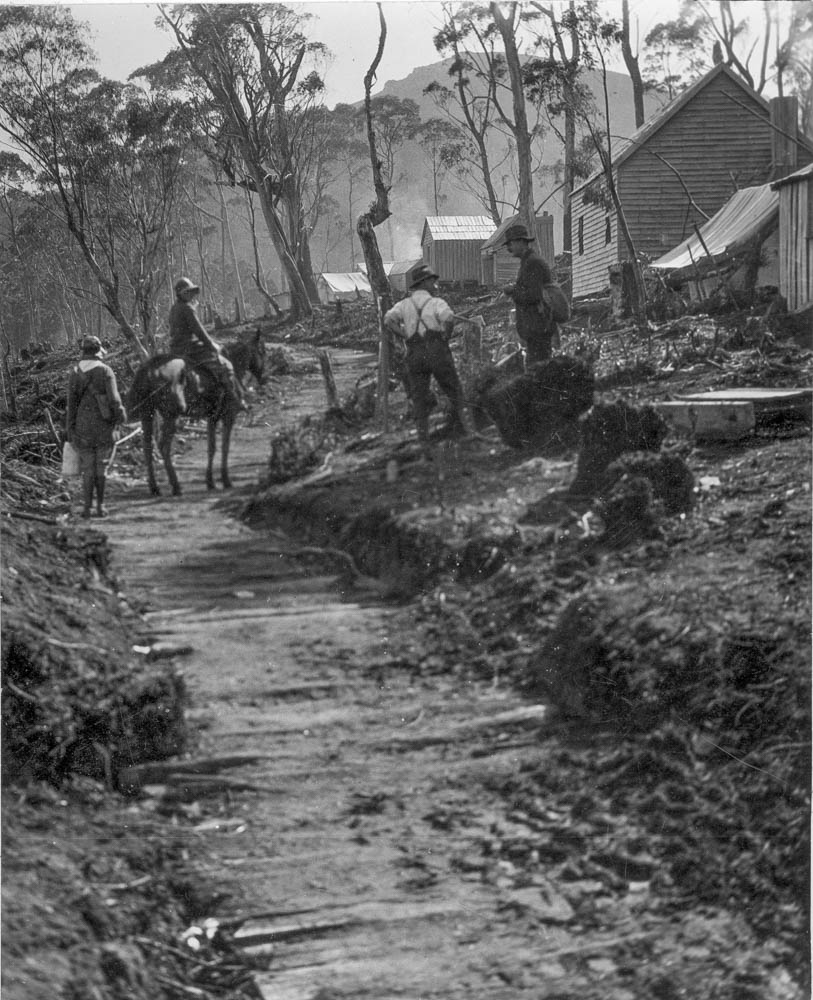
Main Street Adamsfield, 1926, with Ida Smithies and Florence Perrin. Fred Smithies photo courtesy of the Tasmanian Archive and Heritage Office.
In November 1926 a Mrs Gresson advertised tourist accommodation at the Tasmanian mining settlement of Adamsfield: ‘See Tasmania’s Wild West, the “osie” diggers, Adams Falls, Gordon Gorge’.[1] What extraordinary enterprise for a simple digger’s wife 120 km west of Hobart! However, when you learn what an extraordinary woman Lily Gresson actually was, this visionary behaviour comes as no surprise at all.
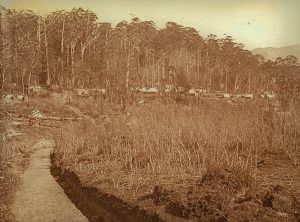
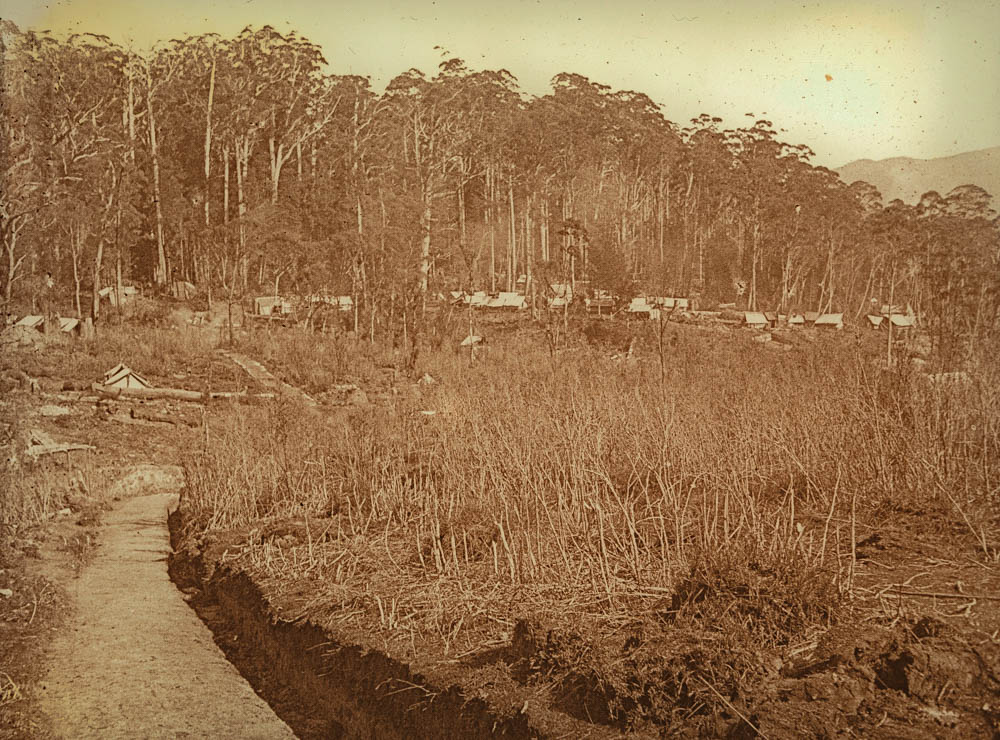
A water race and the village of Adamsfield, 1926, Fred Smithies photo courtesy of the Tasmanian Archive and Heritage Office.
Her old school Airbnb advert was probably shaped by two events: meeting the one-man promotional band Fred Smithies; and a memorable outing she made to the nearby Gordon River Gorge. Visiting Adamsfield by horseback and pack-horse in February and March 1926, Smithies, an amateur tourism promoter, had snapped the town and its jagged skyline for his travelling lantern-slide lecture ‘A trip through the wilds of the west coast and the osmiridium fields’. ‘Gorges of inspiring grandeur’ and ‘magnificent mountain scenes’ also transfixed Gresson. Decades later she recalled that
‘the scenery to the Gordon River was indescribable. Peak after peak of snow-capped mountains and the Gordon Gorge was so precipitous we would scarcely see the bottom … [it] … was like so many battlements’.
Her party ‘cheerfully stalked along the ten miles of wonderful scenery singing bits of popular songs. This was the first time I had heard [‘]Waltzing Matilda[’], she recalled, ‘and it certainly cheered and helped us along, and home again, when we’—Lily and her husband Arthur Gresson, a veteran of the Siege of Mafeking during the South African War— ‘were beginning to flag’.[2]
Certainly the outing would have come as welcome relief from the routine of life on the Adamsfield diggings. The Gressons had rushed to Adams River in the spring of 1925, after the Staceys from the Tasman Peninsula and their mates struck payable osmiridium. Lily was a woman of great conviction. At a time when few women dared venture among the thousand or so men on the ossie field, she secured her own miner’s right, put together a side of bacon and other requisites, bundled her twelve-year-old son Wrixon onto the train and off they went to Fitzgerald, the western terminus of the Derwent Valley Line, to join Arthur.
Fitzgerald was still 42 km from Adamsfield. Meeting his family there, Arthur hired five horses, including one for Wrixon, who had never ridden a horse before, one for the packer and another to carry the three months’ supply of food and equipment. It was snowing. In parts of the Florentine Valley the mud was up to the horses’ girths, Lily recalled,
‘and they slithered, slipped and plunged into the side track to keep themselves steady. The track was narrow, hastily prepared in very thick scrub, corduroyed also hurriedly—the edges not even adzed. I pitied the poor ‘gees’ [horses] slipping and floundering to try and gain firm footing. I thought I would soon be slipping over their heads and called out to my husband, “Shall I dismount?” “Certainly not”, was the reply, “or you will never get up again.” So I stayed on as best I could following the packer’s lead, for I was behind him. Presently, just around the corner, he shouted, “Look out, the down packs are coming!”’[3]
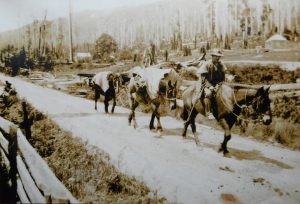
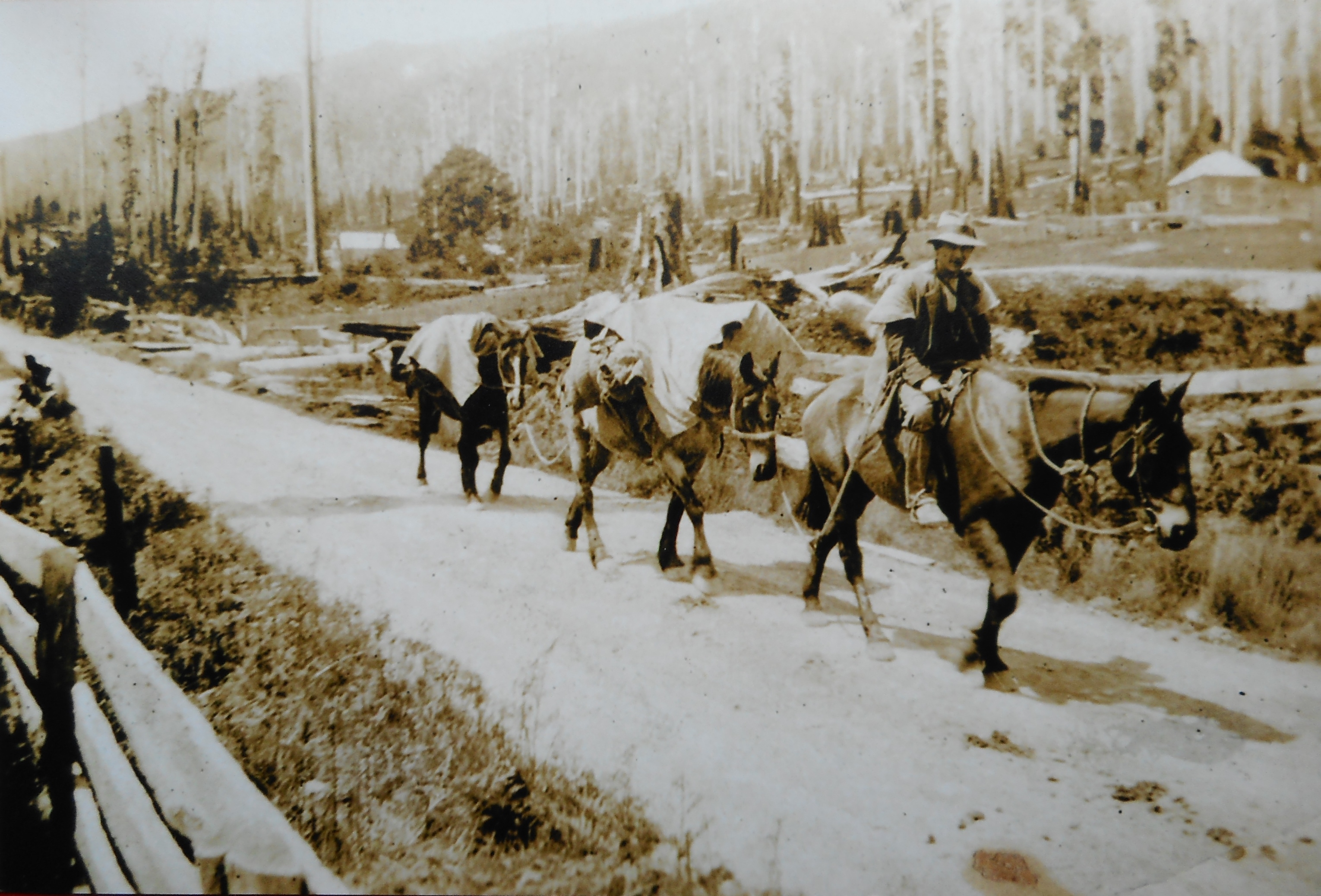
A packer leading a pack-horse team out of Fitzgerald, taking supplies into Adamsfield, 1925. Alf Clark photo courtesy of Don Clark.
This was pack horses returning unsupervised from Adamsfield. When the osmiridium field was reached, the horses were simply released to find their own way back down the track to Fitzgerald. Given that there was no feed between the two centres, the hungry animals galloped wherever they could, a nasty surprise for the uninitiated coming the other way. How the horses survived the return trip without a broken leg is hard to imagine.
The Gresson party stopped for the night at Chrisp’s Hut, a leftover from the 1907 Great Western Railway Survey.[4] It took a further day to reach Adamsfield over the ranges. The mining settlement was ‘a busy seething mass of men and horses, to say nothing of a vast morass of mud, with short stumps sticking up everywhere, quite enough to topple us over’. Arthur Gresson was living in the sort of tent-hut typical of a temporary miner’s quarters. Wrixon slept on a bench in a bark humpy with only a hessian curtain to keep out the cold, while his parents bunked down under a tent fly.
Having obtained the miner’s right, Lily was entitled to peg her own claim measuring 50 yards by 50 years (that is, about 45 metres square), and she set out next morning suitably attired in her lace-up mining boots, riding breeches, short coat and emerald-green rain hat. After she had dug a hole almost two metres deep and obtaining osmiridium-bearing earth, a man ‘jumped’ her claim, taking all the valuable ‘wash’ before she even knew it had happened. Arthur Gresson sent the intruder packing, but the damage was done, and Lily had to start again on a new claim. Soon she was winning tiny nuggets of coarse ‘metal’ by sluicing the ‘wash-dirt’.[5]
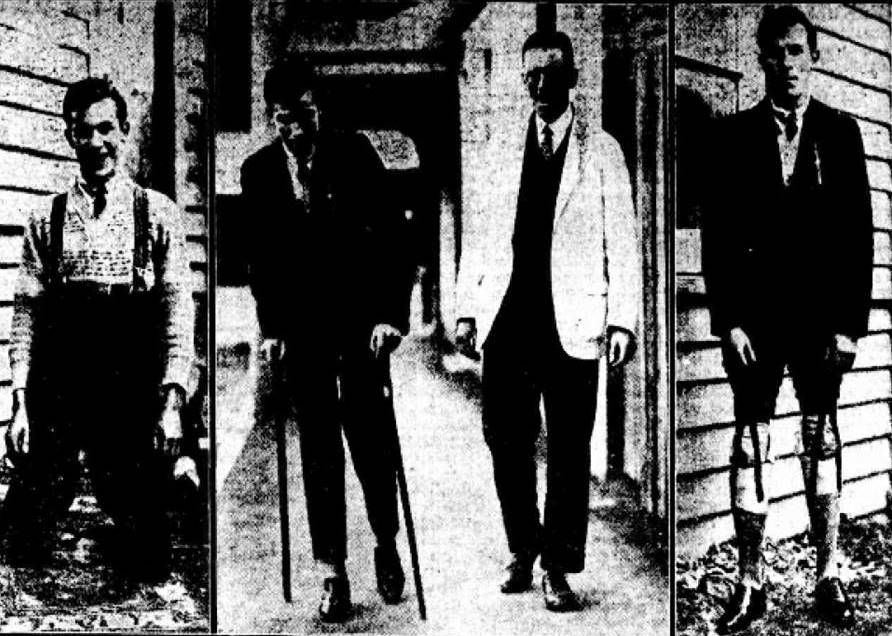
The Gressons remained at Adamsfield through the tough winter of 1926, when the diggers tried to counteract a reduced osmiridium price by selling their metal directly to London. It was tough going through that winter. Many left the field, while others stayed and suffered. Lily recalled the time nineteen-year-old digger Maxwell Godfrey went missing on an icy-cold night. He curled up under a log in the bush, but his legs were frostbitten. Nurse Elsie Bessell, who had only a tent for a hospital, could do little for him, and the news got no better after he was stretchered out to Fitzgerald, slung between two horses. Both his legs were amputated below the knee.[6] A public subscription raised about £500 to help him, and soon he was walking again with the aid of prosthetics.[7]
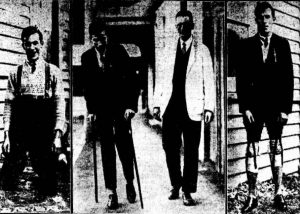
Maxwell Godfrey walks again, from the Mercury, 24 May 1928, p.5.
Lily Gresson, who had had some nursing experience in London, again showed her versatility by looking after the two patients in the hospital while Nurse Bessell accompanied the incapacitated man out to the railway station. Perhaps Lily also home schooled thirteen-year-old Wrixon. There were few children and no school at Adamsfield at this time, so otherwise he would have lost a year of his education.
And the Gressons’ Air B’n’B house? Well, while it was hardly the Adamsfield Hilton, it was comfortable enough by mining frontier standards—a paling hut with a big fireplace and a real glass window.[8] Lily Gresson might have been just a little ahead of her time. Hikers would soon be on their way to Adamsfield and the glorious south-west beyond. Ernie Bond would be besieged with them at times on his Gordon River farm, Gordon Vale, during the 1930s and 1940s. In 1952 the Launceston and Hobart Walking Clubs would even inherit Gordon Vale. Lily Gresson , pioneer of the Adamsfield diggings, was onto something!
With thanks to Dale Matheson, who showed me this story.
[1] ‘Board and residence’, Mercury, 23 November 1926, p.1.
[2] Lily Gresson; quoted by Fred A Murfet, in Sherwood reflections, the author, 1987, p.194.
[3] Lily Gresson; quoted by Fred A Murfet, in Sherwood reflections, p.190.
[4] In her account, Lily Gresson did not mention the notorious ‘Digger’s Delight’, the sly-grog shop and accommodation house that accompanied Chrisp’s Hut soon after the Adams River rush began. Perhaps Ralph Langdon and Bernie Symmons had already moved on into down-town Adamsfield, building Symmons Hall with its accompanying illegal boozer.
[5] Lily Gresson; quoted by Fred A Murfet, in Sherwood reflections, p.192.
[6] ‘Bush nursing’, Mercury, 22 July 1926, p.11; Elsie G Bessell, quoted by Marita Bardenhagen, Adamsfield bush nursing paper, presented at the Australian Mining History Association conference at Queenstown, 2008; ‘Sufferer in bush’, Mercury, 24 May 1928, p.5.
[7] ‘Maxwell Godfrey Fund’, Mercury, 27 July 1927, p.3; ‘Maxwell Godfrey walks again’, and ‘Sufferer in bush’; both Mercury, 24 May 1928, p.5.
[8] Lily Gresson; quoted by Fred A Murfet, in Sherwood reflections, p.192.
by Nic Haygarth | 28/07/17 | Tasmanian high country history
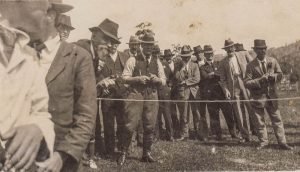
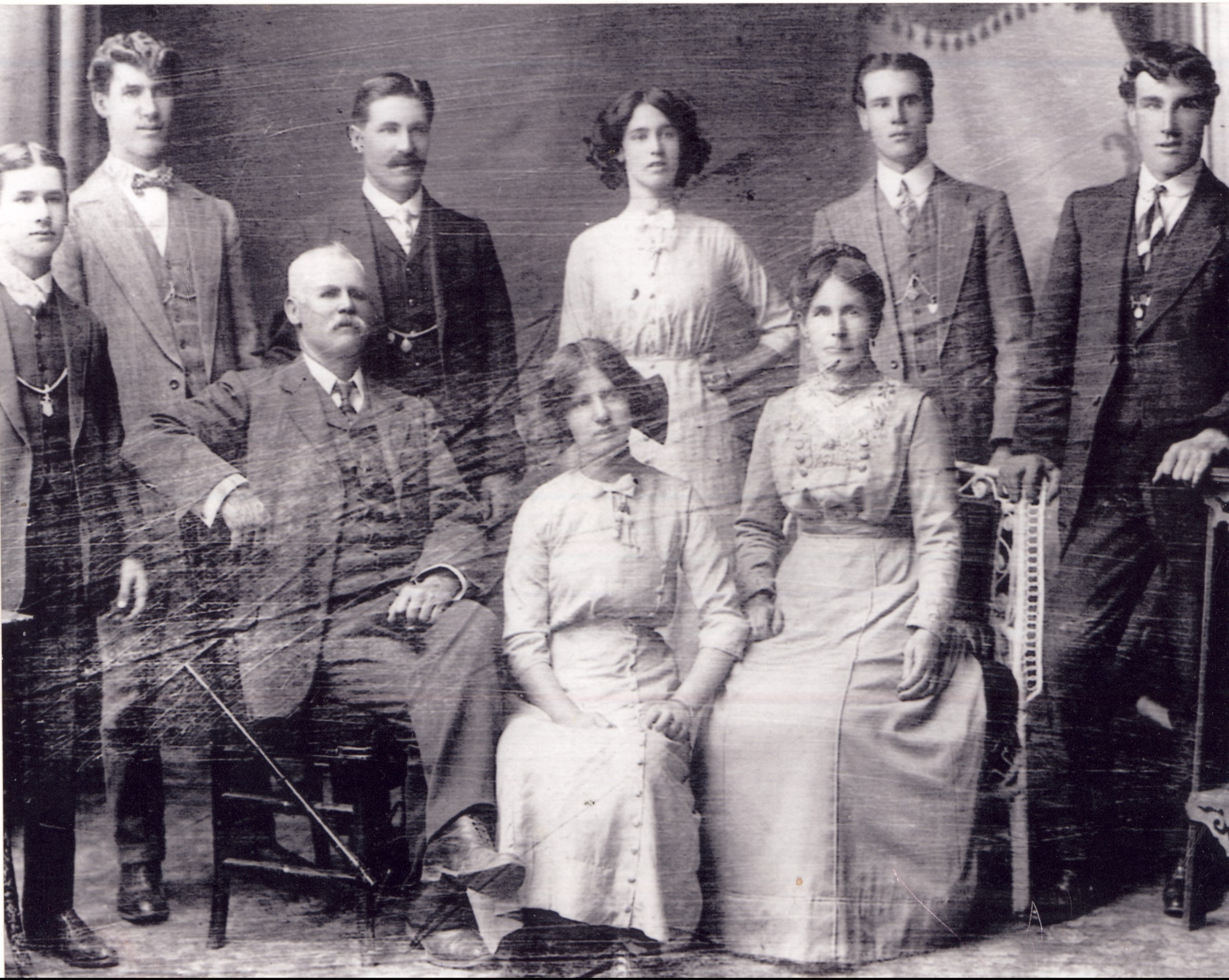
Jim Stacey, with beard and hat, peering into the camera, at a public function late in life. Photo courtesy of Maria Stacey.
It was Tasmania’s biggest rush since the Lisle gold craze of 1879. The year was 1925, the commodity was osmiridium, the place was the Adams River, 120 km west of Hobart—and the name on everybody’s lips was Stacey.
Two generations of Staceys, a Tasman Peninsula family, drove the discovery and development of what became Adamsfield. Yet the story of the brothers Jim and Tom Stacey shows how capriciously fortune was apportioned to mineral prospectors. Perhaps Jim Stacey somehow offended St Barbara, patron saint of miners. For all his initiative and enterprise in the field, he made no money. His brother, on the other hand, turned up when the work was done and made a killing.
Jim Stacey was born at Port Sorell on 28 October 1856 to Robert Stacey and Kara Stacey, née Eaton.[1] As a young man, tin commanded his attention. By the age of 20 he was at Weldborough, on the north-eastern tin fields, with two of his brothers, one of whom died there from suspected exposure.[2] Jim Stacey then went to the Mount Bischoff tin mine at Waratah, where his mining education continued. He recalled meeting the mine’s discoverer James ‘Philosopher’ Smith, and learning from him the importance of testing river sands for minerals. Stacey benefited from meeting some of the best prospectors on the west coast—WR Bell (discoverer of the Magnet mine), George Renison Bell (Renison), the McDonough brothers (Mount Lyell), Frank Long (Zeehan) and others. The independence of these men impressed him. He was probably at Mount Lyell in 1886 during the excitement over the Iron Blow, and he later recalled testing the Franklin River for gold.[3]
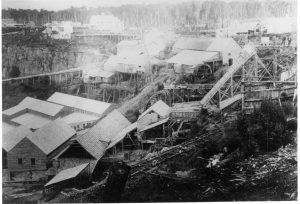
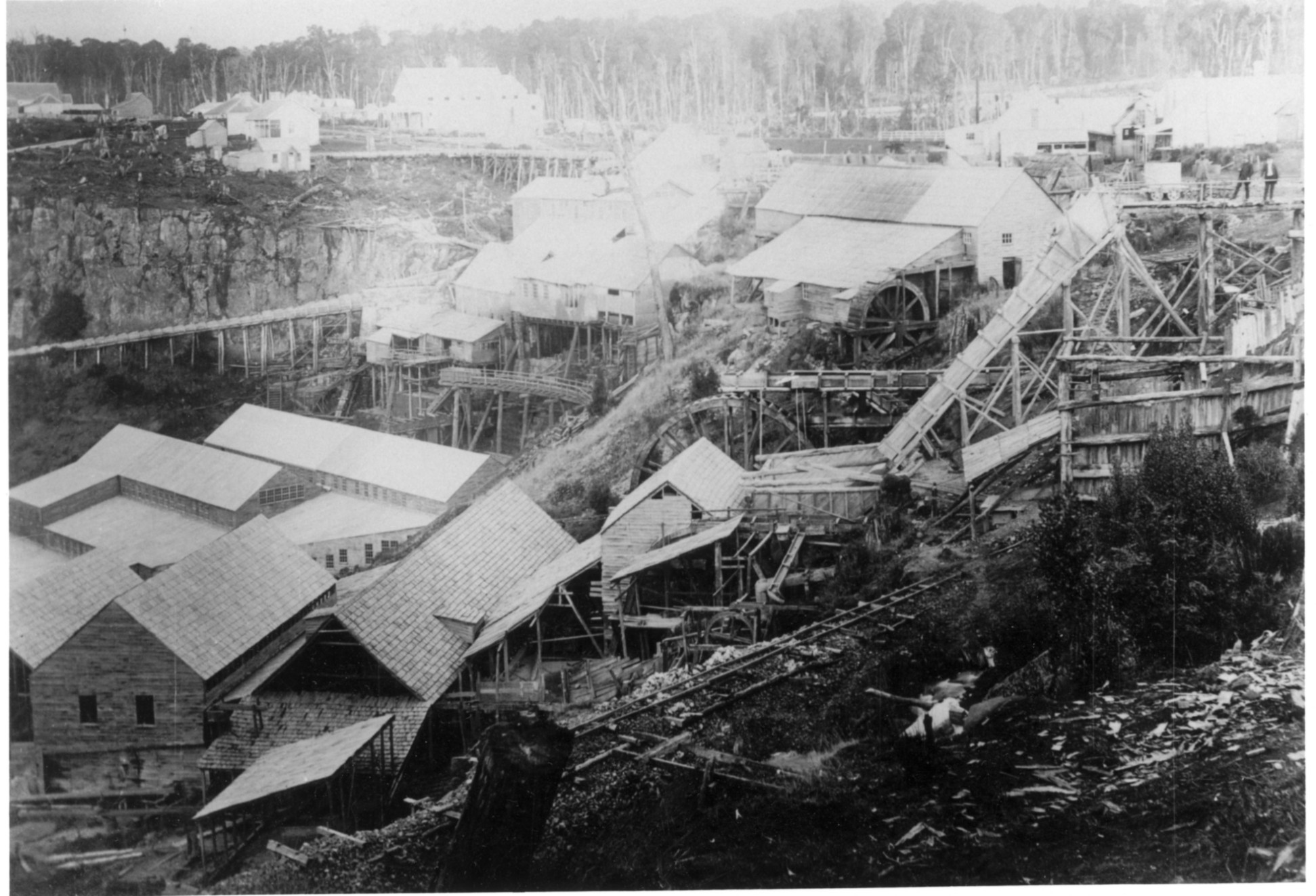
The Mount Bischoff Co and Don Co plants at Waratah, c1890, courtesy of the Tasmanian Archive and Heritage Office.
While at Waratah, Jim Stacey had also married Henrietta Davis.[4] Perhaps the couple had put away some money, because they established a farm at Nubeena on the Tasman Peninsula, where the Stacey family were now settled. By 1907, when he was 51 years old, Jim Stacey was a respectable member of Peninsula society, being an inaugural member of the Tasman Municipal Council.
Jim Stacey’s much younger brother Thomas Arthur Stacey was also a mineral prospector, but there the similarities end. Tom was also born at Port Sorell, but in 1877, 21 years after Jim.[5] Little is known of his early years until in 1906 he married Edith Grace Wright at Koonya on the Tasman Peninsula.[6] To say the marriage was an unhappy one would be an understatement.
During World War One (1914–18), Jim Stacey was the model of patriotism, ‘sending’ five sons to the battlefields and being active in recruitment.[7] Two of those sons were killed, another two were wounded.[8] Other people sought an escape in the war. So it was for Tom Stacey, who must have owned the most peculiar war record in his family. He enlisted at Claremont, Tasmania, under the alias John West to avoid maintenance payments to his estranged wife and children.[9] When the police tracked him down, he deserted, eventually re-enlisting, under his real name, at Cloncurry in outback Queensland. Stacey reached Cape Town on the troop ship Wyeema in 1918, just as the Armistice was being signed. Returned to Sydney with the rest of the 7th General Reinforcements, he was arrested as soon as he was discharged.[10]
In his sixties, Jim Stacey was reborn as a prospector. The catalyst for it was the discovery of belts of serpentine, the host rock of osmiridium, in south-western Tasmania. In 1924 he led a party which included Fred Robinson, Edward Noye, and his sons Sydney and Stanley Stacey to Rocky Boat Harbour (Rocky Plains Bay) near New River Lagoon. Announcing the discovery of osmiridium there, the old Bischoff man proudly asserted his independence, stating that he took no aid from the government, having first found the metal while prospecting on his own account months earlier.[11] The first sale of osmiridium from southern Tasmania was in January 1925 when Arthur (AH) Ashbolt of AG Webster & Son in Hobart bought a 25-3-13-oz parcel worth £780-10-0 from Nubeena men Robinson, Noye, Jim Stacey and C Clark.[12]
In November 1924 Arthur, Sydney and Charles (‘Brady’) Stacey, plus ‘Archie’ Wright and Edward Bowden of Hobart retraced Government Geologist Alexander McIntosh Reid’s steps by working their way along the South Gordon Track to the Gordon River, then back along the Marriott Track to the Adams River Valley, discovering osmiridium on the western side of the Thumbs.[13] Wanting confirmation of their find from the experienced Jim Stacey, they arranged to meet him at the Florentine River in February 1925. Jim Stacey and party made their own osmiridium discovery independently on a different site near the head of Sawback Creek, the eastern branch of the Adams River, 120 km west of Hobart by railway, road and sodden, steep mountain track.[14]
From July to September 1925, a quarterly record 1078 miner’s rights were issued in Tasmania, as diggers rushed the field.[15] Jim Stacey was reported to have chosen his reward claim hastily, and won little from it, whereas, ironically, his brother Tom, who had had no part in the early expeditions, ended up with the best claim on the field.[16] In the December quarter for 1925 alone, Tom Stacey pocketed £1186—the equivalent of a six-figure sum today.[17]
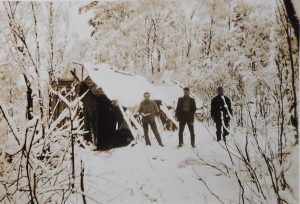
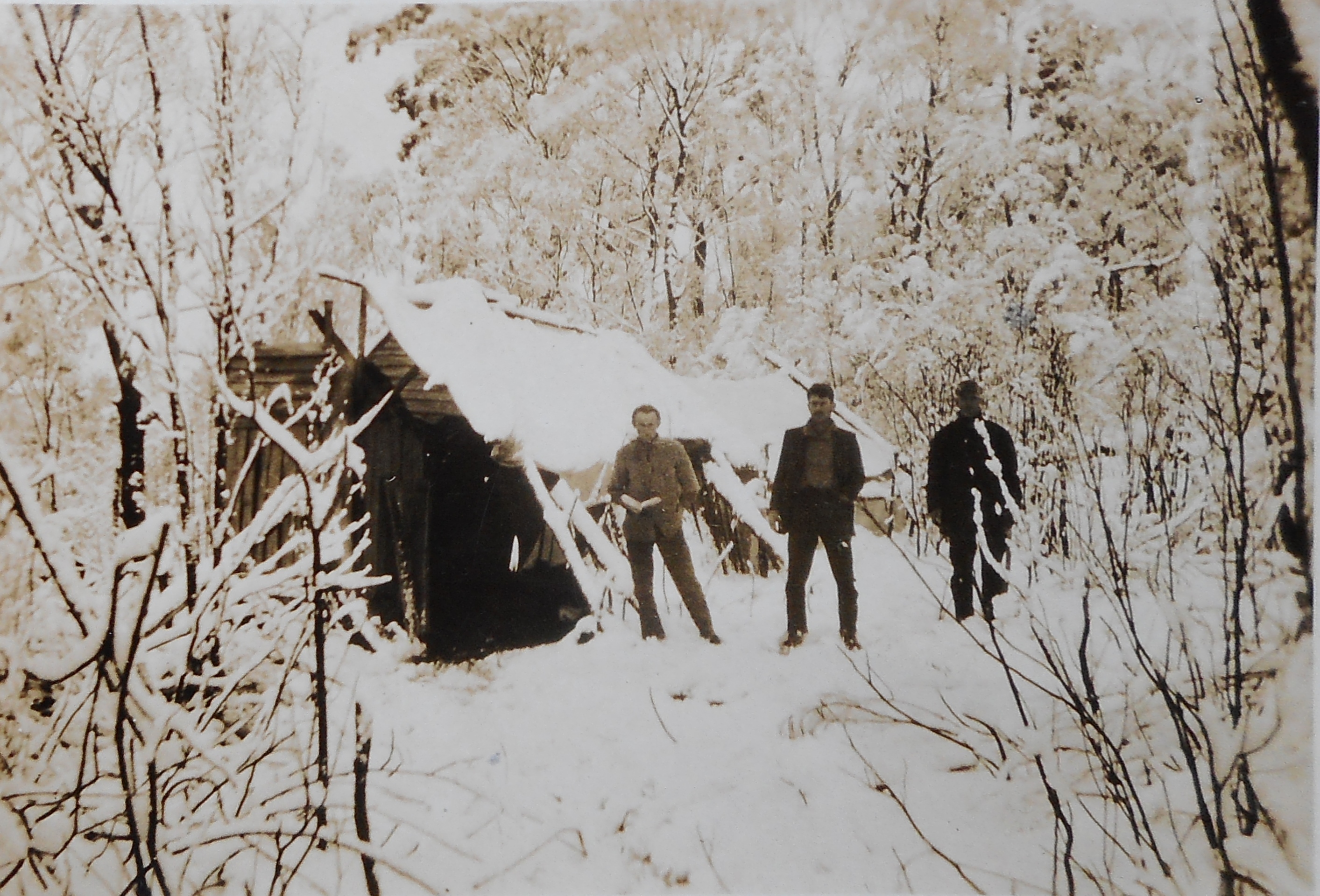
Adamsfield diggers in the snow, autumn 1926. Alf Clark photo courtesy of Don Clark.
Adamsfield ‘new chum’ Horace ‘Jimmy’ Lane recalled turning down Tom Stacey’s invitation to join him as a partner in that rich claim. Lane disliked and feared the unshaven, unkempt ‘Old Tom’, attributing his manner and habits to over-indulgence in rum. Old Tom was well known for the ‘boom and bust’ lifestyle that must have been little comfort to his long-suffering family.[18] North-eastern identity Bert Farquhar may have been exaggerating when he alluded to Tom leaving the field with £12,000 and returning two years later unable to afford a horse to carry him, but the lesson was obvious.[19] Lane told the tale that
‘on one occasion Old Tom had crossed Liverpool Street [Hobart] to test the quality of the liquor at the Alabama Hotel. A naval vessel was in port and there were quite a few sailors in the bar of the Alabama and Tom was getting somewhat more inebriated than usual. He finally reached the point of no return: he offered to fight anyone in the bar for £10 and threw a tenner on the bar to back himself. One of the naval chaps agreed to fight him so Tom demanded that his tenner be covered. However when he turned around there was no money on the counter and no one present would admit having touched it. Tom staggered back to the Brunswick [Hotel, on the opposite side of Liverpool Street] quite convinced that he had lost £20 not £10’.[20]
Hobart General Hospital records show that in 1926 Tom Stacey had sutures inserted in a cut in his face sustained while fighting at Adamsfield.[21] His alcohol-fuelled lifestyle is easily traced today through digitised newspapers. Whatever money he made was soon spent, and he became the epitome of the old diehard prospector. In 1950 Tom Stacey was described as a 73-year-old ‘hermit’ living in a one-room shanty in the bush near Coles Bay, with only a dog for company. That dog hunted kangaroo meat, Old Tom had apple and cherry trees and grew vegetables to sell to guests at the nearby Coles Bay guesthouse. His bed was ‘a piece of sacking spread with fern’, and his ancient trousers were held together only by pieces of wire.[22] He was killed when hit by a car on the Tasman Highway near Sorell in 1954.[23]
Jim Stacey continued to prospect almost until his death in 1937.[24] In 1935, for example, when he was 78 years old, he and two of his sons were paid by the government to spend ten weeks prospecting the Hastings–Picton River area.[25] He died in the company of family and was remembered for his public service, not the least of which was leading the way to Adamsfield, where some gained a start in life and others scraped a living through the Great Depression. Stacey Street, Adamsfield, is overgrown by bracken fern, and Staceys Lookout on the Sawback Range, unvisited, but the twisted landscape of the mining field still recalls his skills, perseverance and vision.
[1] Birth record no.1518/1886.
[2] ‘Sudden death at Thomas Plains’, Launceston Examiner, 29 May 1878, p.2.
[3] RJ Stacey, ‘Exploring for minerals’, Mercury, 8 December 1907, p.6.
[4] The marriage on 18 February 1886 was registered at Emu Bay, no. 1266/1886.
[5] Birth record no.1687/1877.
[6] ‘Family notices’, Mercury, 2 June 1906, p.1.
[7] ‘The recruiting scheme’, Daily Post (Hobart), 17 February 1917, p.7; ‘Workers’ Political League’, Mercury, 21 December 1916, p.5.
[8] For the death of John Stacey, see ‘Tasmania: Nubeena’s avenue of honour’, Mercury, 5 November 1918, p.6. William Stacey joined E Company, in the New Zealand Army (see Nominal Roll, no.62, p.19, 1917). For his death see ‘Roll of honour: Tasmanian casualties’, Examiner, 12 November 1918, p.7. Thomas Albert Stacey and Robert Stacey were both wounded twice in France. Robert was also shell shocked.
[9] John Hutton to Sergeant Ward, 2 September 1916, SWD1/1/713 (TAHO).
[10] Note added to Police Gazette (Hobart), 12 January 1917, p.10.
[11] ‘Osmiridium: reported discovery’, Advocate, 8 September 1924, p.2.
[12] ‘Register of osmiridium buyers’ returns of purchases, September 1922–October 1925’, MIN150/1/1 (TAHO).
[13] ‘Mining reward: discovery of osmiridium’, Examiner, 20 December 1934, p.7.
[14] PB Nye, The osmiridium deposits of the Adamsfield district, Geological Survey Bulletin, no.39, Department of Mines, Hobart, 1929, p.3.
[15] ‘Osmiridium: Tasmania’s unique position’, Mercury, 29 September 1925, p.9.
[16] ‘Romance of Adams River’, Examiner, 25 December 1925, p.5.
[17] ‘Register of osmiridium buyers’ return of purchases’.
[18] For the trials and tribulations of Edith Stacey and her four children, see file SWD1/1/713 (TAHO). For Tom Stacey’s battles with liquor laws, see, for example, ‘Police Court news’, Mercury, 13 August 1927, p.3. Convicted of sending a child to buy alcohol for him, Stacey took six years to pay the small resulting fine (Police Gazette, 6 October 1933, p.204).
[19] Bert Farquhar, Bert’s story, Regal, Launceston, 1990, p.3.
[20] Horace Arnold ‘Jimmy’ Lane, I had a quid to get, the author, Stanley, 1976, p.63.
[21] ‘Register of applications for treatment, Outpatients Department’, Hobart General Hospital, 11 September 1926, HSD130/1/3 (TAHO).
[22] ‘A solitary bushman’, Examiner, 16 September 1950, p.7.
[23] ‘New clue found to hit-run motorist’, Mercury, 25 August 1954, p.5.
[24] Nubeena’, Mercury, 5 January 1938, p.9.
[25] See file AB964/1/1 (TAHO).