by Nic Haygarth | 09/07/17 | Tasmanian high country history
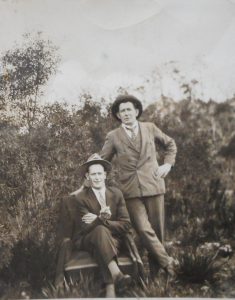
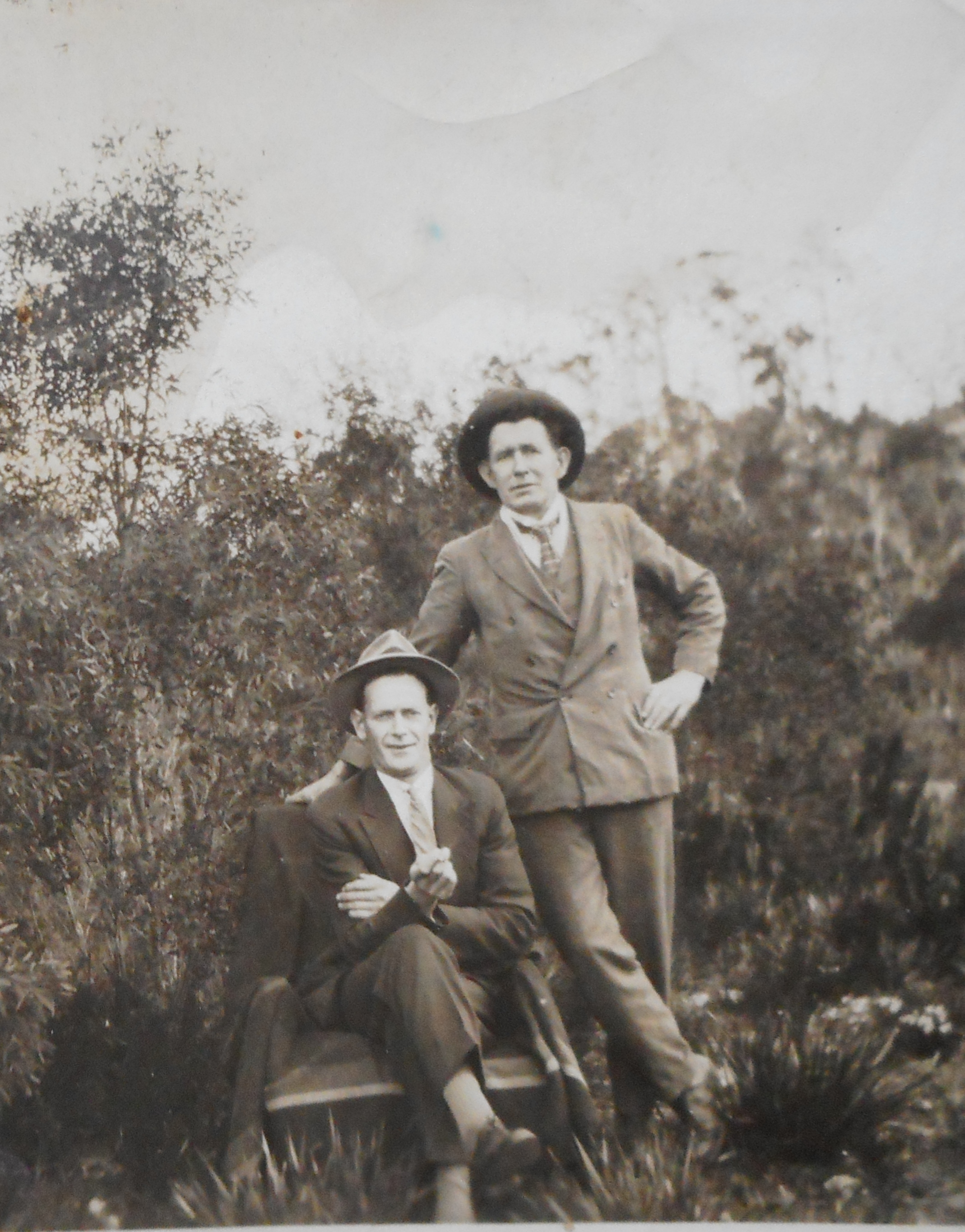
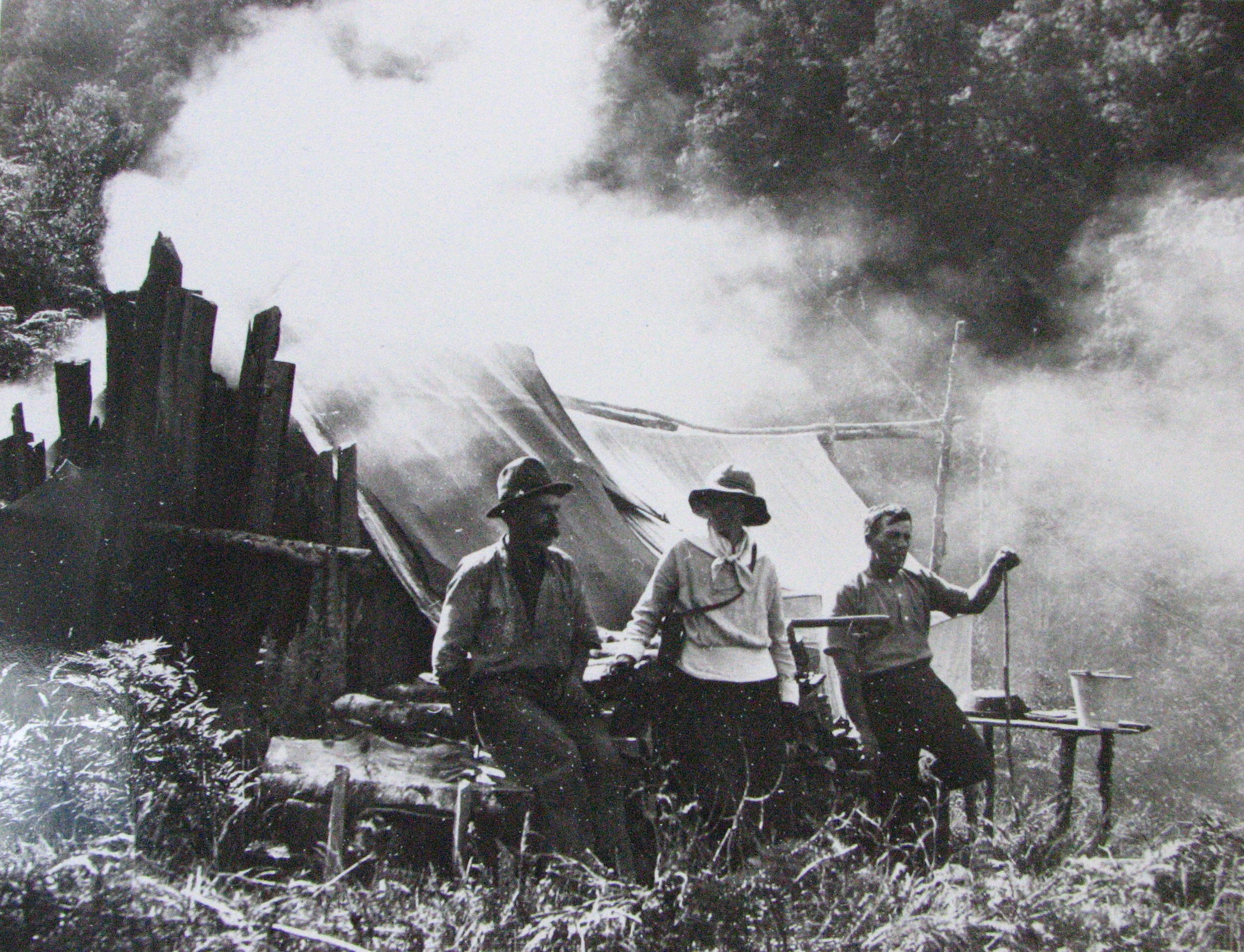
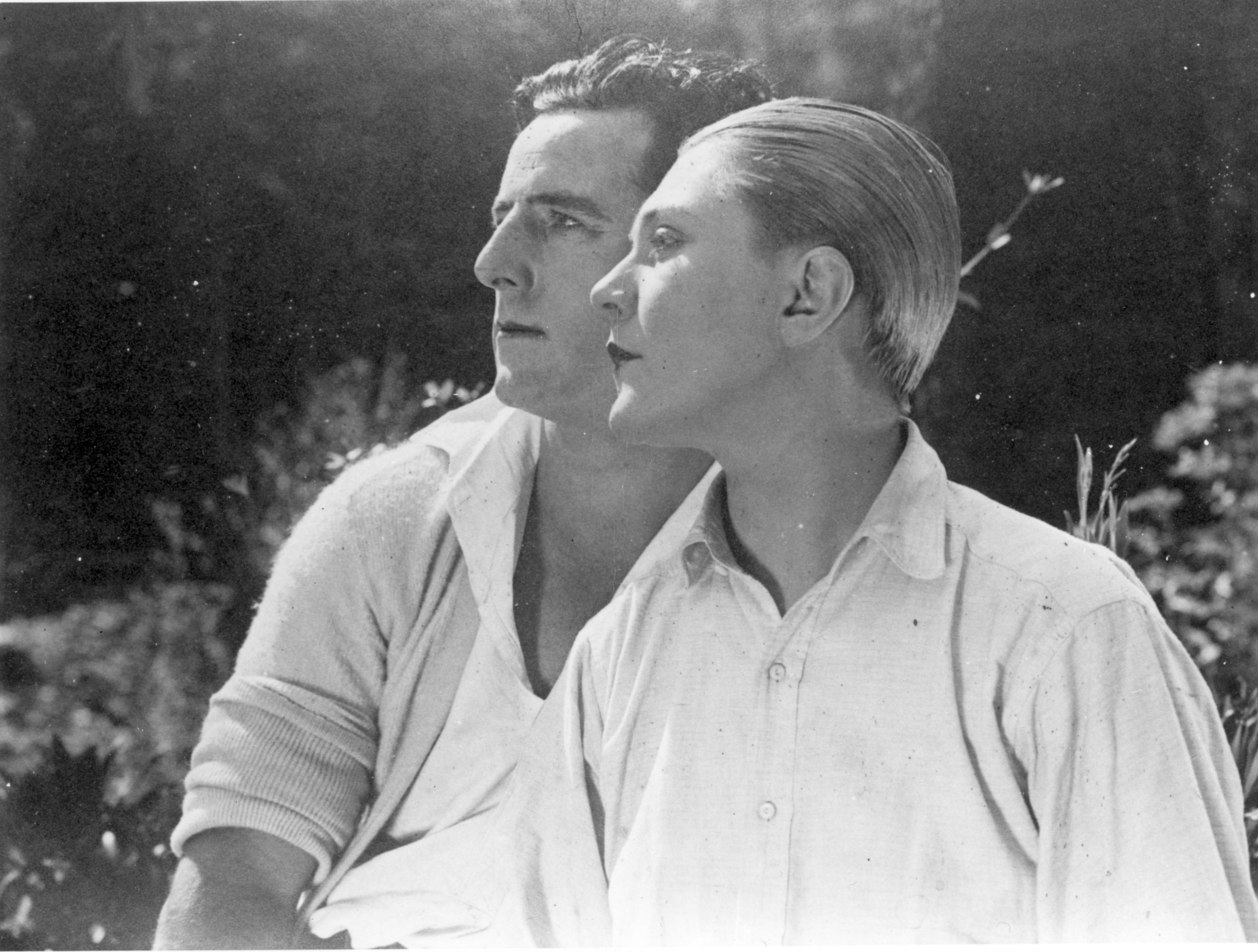
‘Mulga Mick’ O’Reilly (standing) and friend at Adamsfield, courtesy of the Tasmanian Archive and Heritage Office.
He was Irish, he was a dyed-in-the-wool member of the Labor Party, and he was a socialist. Those are things we can say with certainty about the ‘voice of Adamsfield’, ‘Mulga Mick’ O’Reilly. Beyond that, a lot of his life is open to debate. This well-travelled digger wrote two books, The Pinnacle Road and other verses (1935), which was a collection of his poems, most of them from his Tasmanian days, and the autobiography Bowyangs and boomerangs: reminiscences of 40 years’ prospecting in Australia and Tasmania (1944).
How reliable were they? Mick’s son John O’Reilly recalled his aunts saying that Bowyangs and boomerangs was mostly fabrication. In it he claimed tragic beginnings. Having been born at Shinrone, County Offaly, Ireland, in 1879, he lost his first wife and two sons in an influenza epidemic before coming to Australia. [1]
One of the things that makes it hard to keep track of ‘Mulga Mick’ is his way of acquiring other people’s memories. He loved to compose stirring poetry. He wrote as if he was the spirit of mineral prospecting, speaking for all the diggers. One of his efforts, ‘The men of ‘93’, was written about times on the Western Australian goldfields he probably never experienced. Perhaps he recorded the stories of old diggers, and then, like a true dramatist, he gave these immediacy by writing them up in the first person.
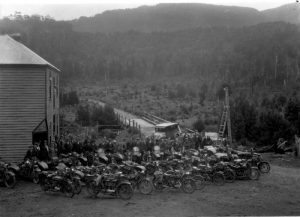
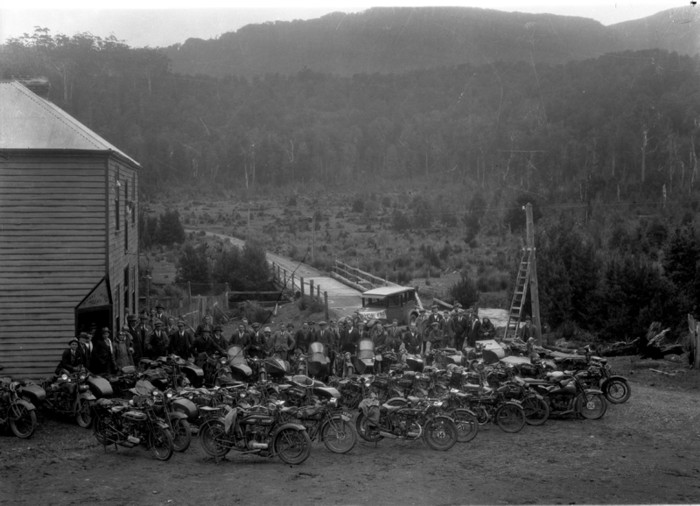
The Whyte River Hotel besieged by motorcyclists, probably in the 1920s. JH Robinson photo courtesy of the late Nancy Gillard.
In 1933 he wrote a lament for the Whyte River Hotel, which was the watering hole for the Nineteen Mile osmiridium field west of Waratah. The pub burnt down in 1929—and O’Reilly probably never laid eyes on it. Yet he described it with the utmost intimacy. Reading his poem, you would swear he had tied one with Jim McGinty, Tom Rouse, Sammy Dwyer and all the other veterans of the field. Even ‘old Burly Lynch’ the publican, lining the drinks up on the bar, got a run. Yet Lynch surrendered the licence of the Whyte River Hotel in 1912, many years before O’Reilly arrived in Tasmania.[2]
Likewise, ‘The Adams River Rush’ described an event he hadn’t attended.[3] The rush occurred in the spring of 1925. He was certainly at Adamsfield in 1928, and through the Great Depression years, the toughest times on that osmiridium field. During these years he delivered missives from the diggings that captured many facets of the experience—the longing for loved ones and the comforts of town; the misery of stirring from a warm bed to work in the mud; comic arguments and drunken fist fights; and the general scrap to make money and hang on to it.
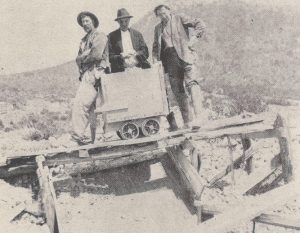
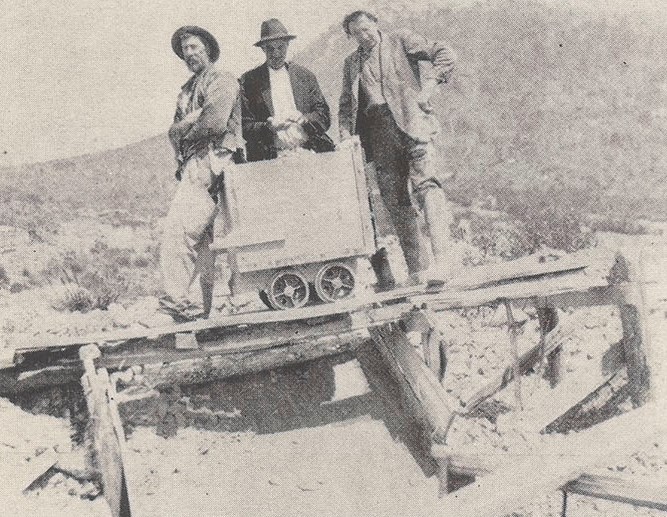
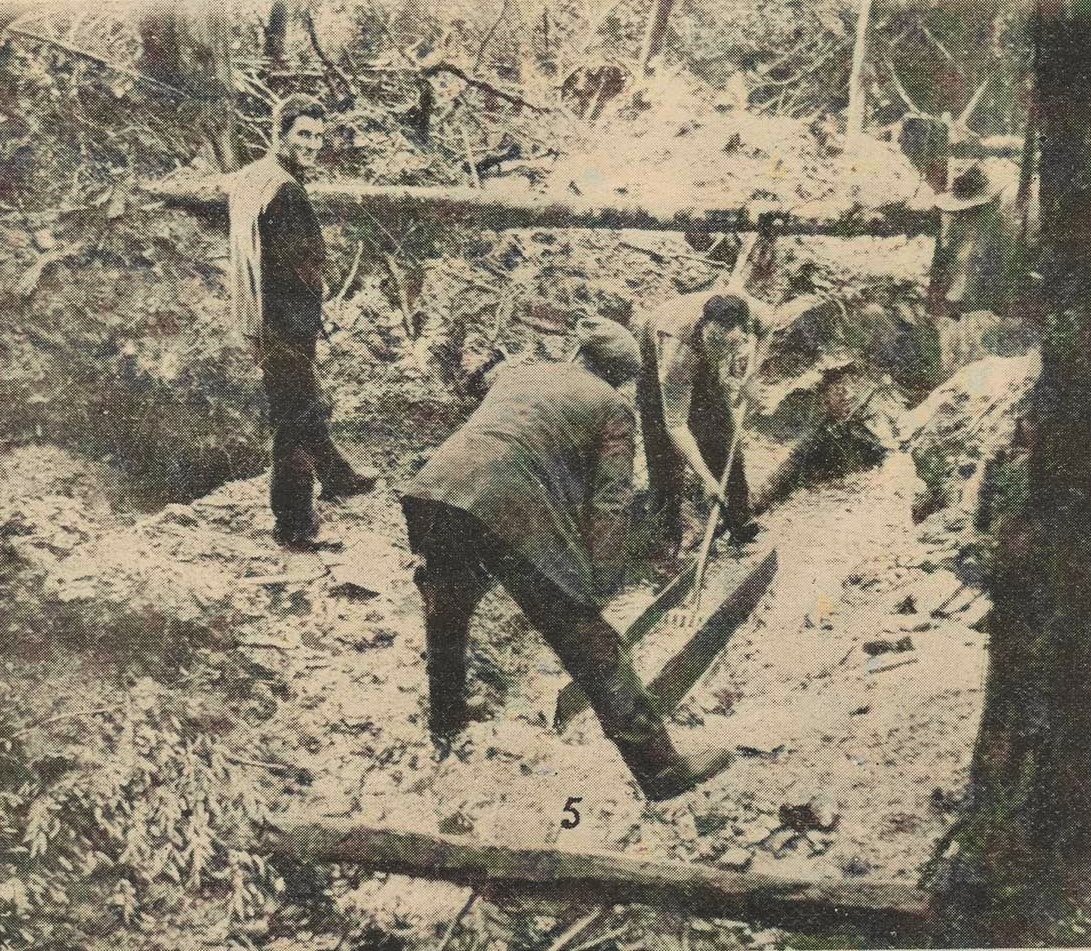
‘Mulga Mick’ (at right) trucking ore to the bin tip, with harry Hill and James Harrison, from the Tasmanian Mail, 13 January 1932, p.35.
Life was very simple for O’Reilly. The world was divided into ‘haves’ and ‘have nots’, that is, the parasite (the master) and the exploited (the servant). O’Reilly spelt ‘Digger’ with a capital ‘D’, whether that be the diggers of Adamsfield or the diggers of Gallipoli, because to him they were of the same manly ilk. All politicians were parasites who took the food from children’s mouths.[4] Miners’ wives and Adamsfield bush nurses were angels.[5] The press was also parasitic and should be ‘cleared from the face of all lands’, except, presumably, when newspapers bore his own copious contributions.[6] His penmanship was fluent, eloquent and often sympathetic to the down-trodden and forgotten, like the ‘heroes’ of Gallipoli, the elderly, the poor.[7] O’Reilly saw the Adamsfield osmiridium field as the epitome of the worker’s struggle for survival with dignity. He urged the workers to strike a blow for freedom against ‘pampered parasites [stealing] our children’s bread’, citing a particularly pathetic example of a large, young family forced to trudge out to the remote diggings.[8] ‘Out latest hospital: is not finished yet’, published in Hobart newspaper the Voice in 1931, was a protest about poor public infrastructure. Adamsfield was in the ridiculous situation of having a hospital with no bathroom, patients having to bathe in a passing water race:
‘When the smoke goes curling through the hole
Where the chimney ought to be,
And the old black billy on the fire
To make the evening tea;
When the hurricane lamp is lighted up,
Then you can safely bet,
It looks more like a Digger’s Camp
That is not finished yet.
If a patient ever gets a bath,
It’s on the instalment plan,
With just a little drop each day
From out the billy-can.
He rubs himself both her and there
Till he is partly wet:
Some day he may get over all,
For the bathroom’s not finished yet.’[9]
There was plenty of humour in his verse. When Jack Brennan claimed to have found a lode of osmiridium, O’Reilly predicted that it would only bring him enough money to buy a new commode.[10] In ‘The lady dentist’s visit to Adamsfield’ he described the anticipation of some rare female attention when Hobart dentist Olive Shepherd decided to make a business call to the diggings:
‘Some developed toothache that had never had a tooth
Since their father’s hairy lug they used to bite,
Another one’s got gumboils all around the ancient root
Of the one and only molar that’s in sight …
Not for years can we remember when excitement ran so high,
Or a ‘shepherd’ caused such stir among the sheep.
Now the old and toilworn Diggers wear a collar and a tie,
It’s enough to make the blooming angels weep.’[11]
However, O’Reilly’s pet plan to increase digger prosperity and extend the life of the osmiridium field was deadly serious. He wanted the government to fund a scheme to drain about 1000 acres of swampy flats along the Adams River which he claimed he had already tested successfully for metal. Without producing a single assay report as evidence, he claimed this would return about £200,000-worth of osmiridium.[12] The idea was to drain the area by way of a deep tail race terminating at the Adams River Falls, although others hit upon a more radical plan to blast away the falls themselves, thereby increasing the river flow. Asked to report on the scheme in 1931, Government Geologist PB Nye claimed that the area which would benefit from drainage was at most 667 acres and that insufficient work had been done to prove that the ground in question contained payable osmiridium—let alone osmiridium that would justify an outlay of anything up to £10,000 on such a tail race.[13]
O’Reilly retired to Glenorchy, took a job as a labourer building the Pinnacle Road up Mount Wellington, above Hobart, and continued to fire off instructions for a better world. St Peter probably copped an earful as ‘Mulga Mick’ stormed the Pearly Gates.
[1] MJ O’Reilly (‘Mulga Mick’), Bowyangs and boomerangs: reminiscences of 40 years’ prospecting in Australia and Tasmania, Hesperian, Carlisle, WA, 1984 reprint, p.160; John O’Reilly, ‘Mulga Mick; prospector, miner, author and poet: a lost father rediscovered’, Tasmanian Ancestry, December 2013, p.149.
[2] The old Whyte River Pub’, Advocate, 16 September 1933, p.8; reprinted in MJ O’Reilly, ‘Mulga Mick’, The Pinnacle Road and other verses, the author, Hobart, 1935, pp.62‒64. The Whyte River Hotel was never rebuilt.
[3] MJ O’Reilly, ‘Mulga Mick’, ‘The Adams River Rush’, The Pinnacle Road and other verses, pp.55–57.
[4] See, for example, ‘Mulga Mick’ (MJ O’Reilly), ‘Stealing the children’s bread: lesson of the Adamsfield Track’, Voice, 30 April 1932, p.7.
[5] For diggers’ wives and bush nurses as angels, see MJ O’Reilly, ‘Mulga Mick’, ‘The ossie diggers’ wives at Adamsfield’, in The Pinnacle Road and other verses, the author, Hobart, 1935, pp.28‒29; and ‘Sister’s sympathy’, Voice, 11 April 1931, p.6.
[6] For the ‘parasitic press’, see ‘Mulga Mick’ (MJ O’Reilly), ‘A poetic exchange’, Voice, 16 May 1931, p.2.
[7] See ‘Mulga Mick’ (MJ O’Reilly), ‘Armistice Day: “We’ll ne’er forget the price”’, Voice, 7 November 1931, p.1; and ‘Stealing the children’s bread: lesson of the Adamsfield Track’, Voice, 30 April 1932, p.7.
[8] ‘Mulga Mick’ (MJ O’Reilly), ‘Stealing the children’s bread: lesson of the Adamsfield Track’, Voice, 30 April 1932, p.7.
[9] ‘Mulga Mick’ (MJ O’Reilly), ‘Not finished yet’; quoted in ‘Our latest hospital’, Voice, 3 January 1931, p.2.
[10] ‘Jack Brennan’s osie [sic] lode’, poem signed ‘Mulga Mick’, dated 1929, and reprinted in CA Bacon, Notes on the mining and history of Adamsfield, Report, no.1992/20, Mineral Resources Tasmania, Hobart, 1992, p.8.
[11] MJ O’Reilly, ‘Mulga Mick’, ‘The lady dentist’s visit to Adamsfield’, The Pinnacle Road and other verses, pp.47–48.
[12] ‘Mulga Mick’ (MJ O’Reilly), ‘Osmiridium diggers’, Mercury, 2 September 1932, p.8; MJ O’Reilly, ‘Adamsfield development’, Mercury, 7 February 1933, p.6.
[13] PB Nye, ‘Proposal to drain the Adams River Flats by constructing a deep tail race at the Adams River Falls’, Unpublished Report, 76–79/1931, Department of Mines, Hobart, p.78; ‘Osmiridium’, Mercury, 16 January 1933, p.5.
by Nic Haygarth | 05/07/17 | Tasmanian high country history
The Adamsfield sly-grog shop was anything but sly—on the contrary, it was an open secret. Commonly known as ‘The Boozer’ and ‘The Miner’s Delight’, it functioned so long as there were thirsts to be quenched, livelihoods to be drowned and punches to be thrown. For two decades it was the toast of south-western Tasmania. The greatest bottle dump in south-western Tasmania attests to osmiridium diggers’ habit of pissing their winnings away.
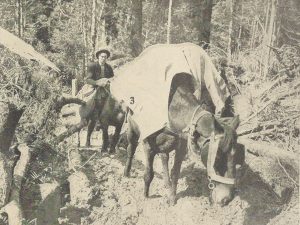
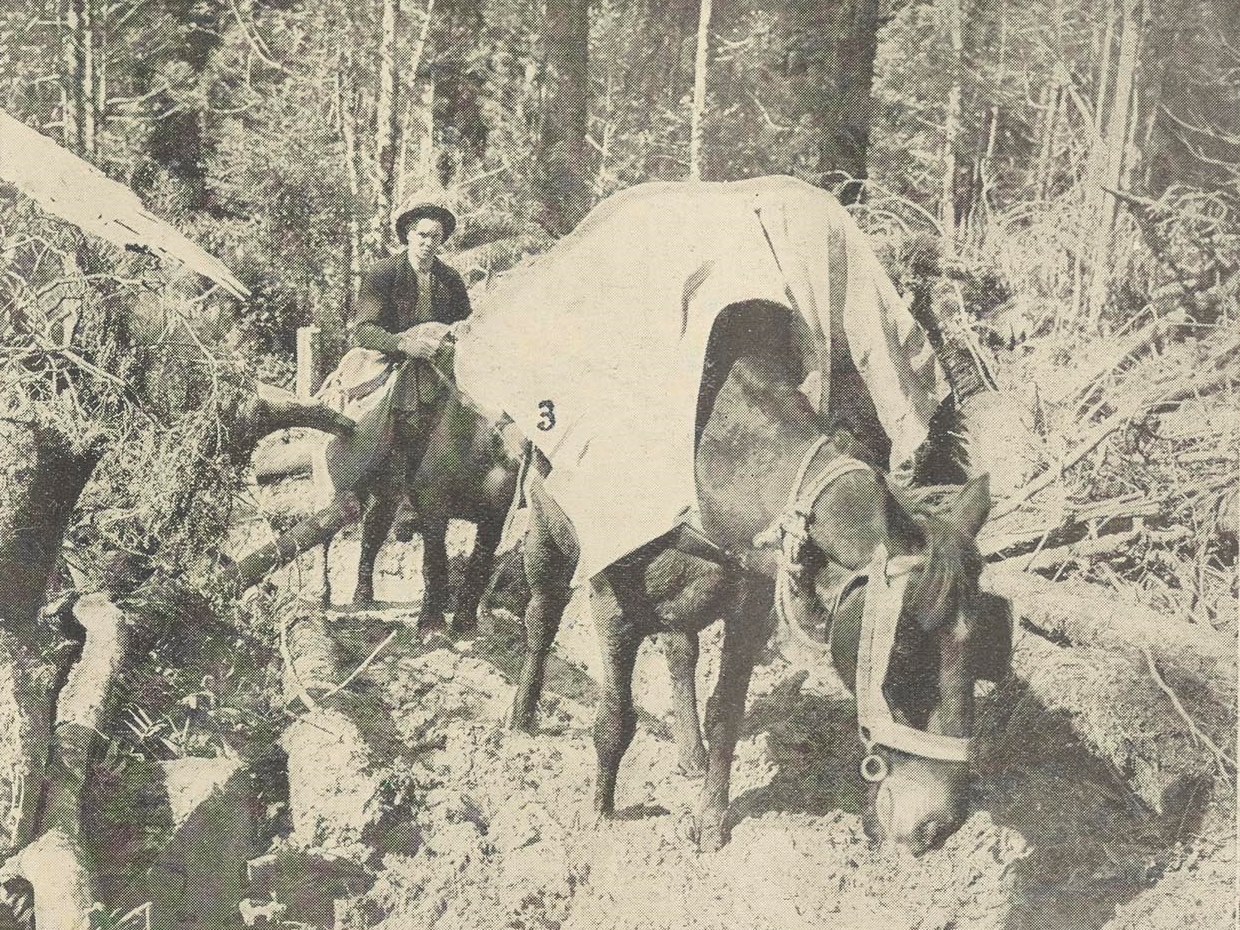
A pack-horse team on its way from Fitzgerald to Adamsfield – all the liquor was brought in surreptitiously. From the Tasmanian Mail, 23 September 1925.
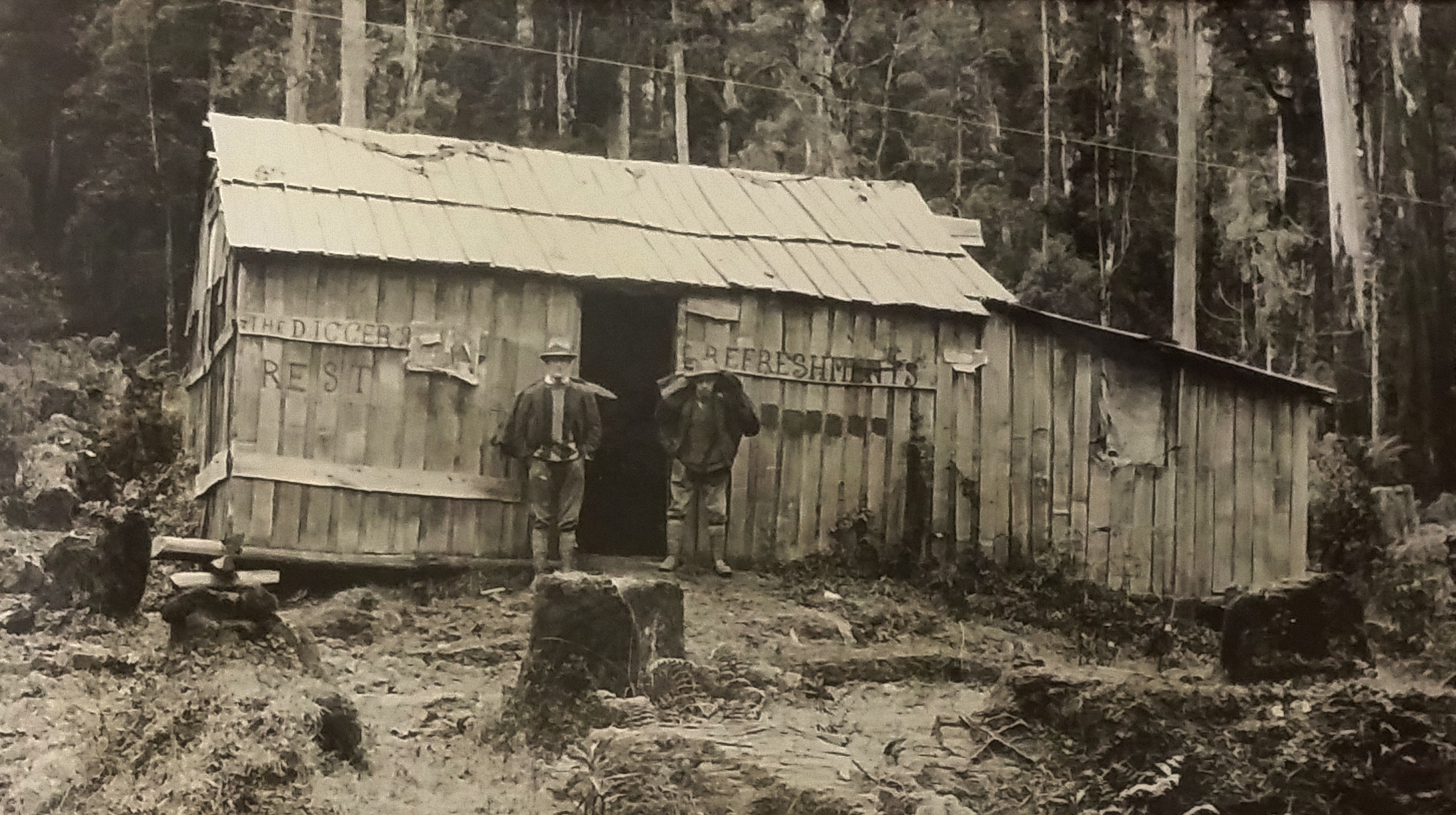
Control the liquor, and you control the town—or so the theory went. In the absence of police, church, bank and any moral authority apart from a committee formed by the diggers themselves, a licensed hotel was surely the key to controlling the reputedly 800- or 1000-man-strong Adams River osmiridium rush of 1925. So it was that in December of that year a licence was granted to well-known publican Eldon Joseph. Lot 10 in the newly surveyed township of Adamsfield was set aside for his establishment, but it burned down during construction and never opened.[1] In its place, Bernie ‘Saviour’ Symmons, as he was known, built a billiard room and sly-grog shop which occupied Lots 9 and 10. Symmons’ partner was Ralph Langdon, and there was a bit of history between them. Langdon had previous convictions for running Hobart gaming houses, including one with Symmons.[2] When the Adams River rush began the pair first operated a ‘refreshment’ hut—that is, a sly-grog and accommodation house known as ‘The Digger’s Rest’—as the first staging post along the 42-kilometre track.[3] Gladys Langdon was the cook and manager there.[4]
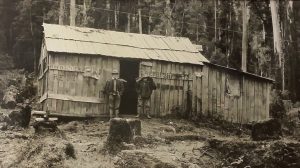
‘The Digger’s Rest’, the first Symmons and Langdon sly-grog shop on the Adamsfield Track, 1929. Cropped from NS1914-1-29, Tasmanian Archive and Heritage Office.
Now Symmons and Langdon were doing the same thing in Adamsfield itself. This establishment, known officially as Symmons’ Hall, was rocked by a bomb in June 1926. The device probably consisted of sticks of gelignite placed inside a jam tin under a bed, and such was the explosion that it rocked a diggers’ camp kilometres away at the Boyes River.[5] Most likely it was not a big job to rebuild ‘The Boozer’ after that, since it would only have been a large paling hut, and soon, inevitably, it was the scene of further ruckuses, fist fights and raids by visiting police.
The most celebrated altercation at ‘The Boozer’ was the one in which digger Arthur Blacklow had the end of his nose bitten off in a drunken brawl, a case which played out as a grievous bodily harm charge in the New Norfolk Police Court. The alleged nose biter was acquitted after a piece of proboscis in a bottle was presented as evidence. Blacklow chose this time to reveal that he could not recognise his own nose:
‘He could not … say that the flesh in the bottle was the piece of nose he gave to the sister [Nurse Johnson, the Adamsfield bush nurse]. The piece given to the sister would be bigger.’[6]
Symmons and Langdon remained partners until 1930, when both left the field. Remarkably, neither was ever busted for selling liquor without a licence. ‘Remarkably’ refers in particular to a 1926 raid on the two buildings that sat on Lots 9 and 10. Sergeant Arnol entered the building on Lot 10, which appears to have been an alcohol warehouse, something akin to a Russian supermarket. Inside he found
- 26 bottles of brandy
- 30 half flasks of brandy and whisky
- 15 bottles of Schnapps
- 1 case of gin
- 1 case of brandy
- 8 bottles of gin
- 8 bottles of ‘special’ whisky
- 13 bottles of rum
- 50 flasks of gin and Schnapps
- 3 bottles of ale
- boxes consigned to R Langdon, Fitzgerald
Arnol charged John Holder, who was on the premises, with selling liquor without a licence, but he could not prove that Holder was the owner of the premises.
Sergeant Arnol also went next door to the building on Lot 9, where he found Ralph Langdon, plus a counter with 14 empty beer glasses on it, a bottle of gin, a bottle of rum, a 9-gallon cask of beer and other empty casks. He charged Langdon with selling liquor without a licence. However, because the premises were registered in the name of Bernie Symmons, the charge could not be sustained.[7] Failure to convict in the face of overwhelming evidence probably did nothing for Arnol’s career prospects.
Ralph Langdon’s story has other priceless elements. One is that when he sold his business in Adamsfield he got into an argument with the buyer, John Gladstone, and the sale of a sly-grog shop ended up being adjudicated on in the Supreme Court in 1931.[8] The second is that Langdon put his takings from his Adamsfield business into buying the lease of the Wheatsheaf Hotel in Hobart.[9] Did he wow the Licensing Board with ossie field testimonials?
Langdon’s successors in the Adamsfield sly-grog trade, John Gladstone and Elias Churchill, were both nabbed for selling liquor without a licence at ‘The Boozer’ in 1930.[10] Churchill followed Langdon by becoming a Hobart publican. In 1934 Langdon had the Wheatsheaf and Churchill had the Duke of York.[11] William Francis Powell, an old Victorian digger who had come to Adamsfield via Savage River, replaced them in the senior apprentice position at ‘The Boozer’. Powell’s sly-grog shop, which slowly disintegrated among the bracken ferns after his death in 1946, is still marked by an impressive bottle dump—last resting place of ‘The Miner’s Delight’, or the true ‘bank’ of Adamsfield.[12]
[1] ‘Hotel for Adams Field [sic]’, Mercury, 10 December 1925, p.10.
[2] ‘Successful police raid’, News (Hobart), 6 January 1925, p.3.
[3] ‘The “Ossy” field’, News, 5 November 1925, p.1
[4] ‘Whose property?’, Mercury, 1 December 1933, p.6.
[5] ‘Sensation at Adamsfield’, Mercury, 3 June 1926, p.6; ‘Adamsfield: the recent bombing case’, Mercury, 9 June 1926, p.9.
[6] ‘Adamsfield affray’, Mercury, 19 November 1931, p.2.
[7] ‘Alleged sly-grog selling’, Mercury, 8 January 1927, p.2. ‘Registered’ does not refer to holding a liquor licence. Under the various Crown Lands Acts, a residence licence could be obtained to take possession of and occupy up to a quarter of an acre of land.
[8] ‘Supreme Court’, Mercury, 16 September 1931, p.11.
[9] ‘Whose property?’, Mercury, 1 December 1933, p.6.
[10] ‘Sly grog at Adamsfield’, Advocate (Burnie), 30 June 1930, p.5.
[11] ‘Licensing Courts’, Mercury, 29 October 1934, p.2.
[12] ‘Family notices’, Mercury, 9 March 1946, p.10.
by Nic Haygarth | 16/06/17 | Tasmanian high country history

John Baptiste (left), a female visitor and a fellow digger at camp, Savage River, in 1924. Fred Smithies photo, NS573-4-4-1, Tasmanian Archive and Heritage Office.
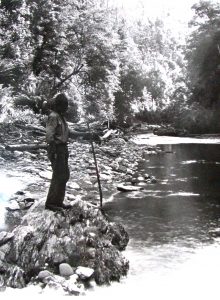
John Baptiste, aka Hooky Jack, hides his metal hook hand, Savage River, 1924. Fred Smithies photo, NS573-4-2, TAHO.
Old Hooky was no new chum—
All his life he’d chased the gold.
And judging by his ‘skiting’
Won—and squandered—wealth untold.
He’d chased it in the Yukon,
In Alaska’s ice and snow,
And north from hot Coolgardie
Where the toughest only go.[1]
The toughest also tackled Tasmania, chasing osmiridium, and that’s where ossie digger Henry Humphries penned these words about his old mate ‘Hooky Jack’. The one-armed prospector, born as John D’Ahren Baptiste, spent at least three decades on Australian shores chasing everything that glittered. And he had a way of finding it:
A lucky man was Hooky and,
In truth, no matter where
He sank the most unlikely hole
There’d be some ‘metal’ there.[2]
Luck or skill? I fancy the latter. You don’t storm goldfields without learning the how, where and why of finding precious metals.
But who was Hooky Jack, and where did he come from? He is said to have inherited the equivalent of £30,000 ($60,000) in his home town of Madeira, Portugal, back in the 1880s, before embarking on his tour of world goldfields.[3] Perhaps squandering his inheritance was the start of a dissolute life, a rollicking refrain of tramp steamers, bars, brothels and all the trappings of the wild west.
It seems unlikely that Baptise made a fortune on Australian gold or Tasmanian osmiridium, although, admittedly, he is a hard man to track on local soil. Prospectors of a century ago often managed to elude electoral rolls, censuses and other public records. Although ships’ logs, gazetted mining leases and court cases are the historian’s allies, the John Baptistes of Australia take some sorting. Newspapers of his day bore so many references to the biblical John the Baptist, to St John the Baptist churches, guilds, fetes, lodges and French statesmen that following the prospector’s life is a painstaking affair. He wasn’t John Baptiste the Portuguese sailor executed for murder at Perth in 1900.[4] Nor was he the Sydney nurseryman John Baptist, and as for the Parisian sausage maker and confectioner from Wagga Wagga … let’s just say that these would be surprising career moves for a carousing wastrel.[5]
Happily, John D’Ahren Baptiste had some distinguishing characteristics which aid identification. One was his love of rum, another the colour of his skin. Baptiste was referred to as a ‘coloured gentleman’ and a ‘half caste’. There was hilarity in a North Melbourne courtroom when in 1895 he was summoned to answer a paternity suit. Baptiste’s defence submitted that the complainant, Annie Boddington, had no proof that he was the father of her newborn. Boddington’s response was to produce the dark-skinned infant, shouting, ‘Haven’t I! He’s a black man—and there’s no mistake about this lot’. The judge seems to have accepted this rather flimsy ‘evidence’, ordering Baptiste to pay maintenance.[6]
Baptiste’s most distinctive trait was his hook. Various prosthetics led the way on the osmiridium fields. ‘Peg Leg Ted’ Loughnan climbed Mount Stewart on one good leg to peg a reward claim in 1917.[7] Lost Adamsfield schoolteacher Tom Cole was tracked along the Gell River by indentations left in the soil by his wooden leg in 1938.[8] It helped carry him into eternity. Baptiste’s metal hook beat those wooden legs for versatility. It raked the fire, served as a fork in food preparation and hoisted the billy from the hot coals. He could saw with it, swing a pick and chop with it.[9] In a brawl he was even said to have used his hook as a club.[10]
Exactly how or when he lost his hand is unknown. Certainly he had the hook during his time on the Gippsland goldfields, Victoria, during the early 1900s.[11] Max Dyer described Baptiste as
‘probably the best miner to ever sluice gold along the Mitta Mitta. Folks used to say that Hookey [sic] could smell gold, as he was never known to have a useless claim. He had a drinking problem as well, and my mother had often told me of Hookey waving his hook in the air and cursing all and sundry … when he was in town on a bender. This only happened occasionally and when he was working his claim he gave it his undivided attention’.[12]
Yes, Hooky Jack knew his business and had plenty of nous. This was apparent when he arrived on the Nineteen Mile Creek osmiridium field nineteen miles west of Waratah. In 1914 stockpiling caused a dramatic slide in the osmiridium price, so he stashed nineteen ounces at the Waratah Post Office and returned to Gippsland, where he registered the Hard to Seek gold claim.[13] Negotiations over sale of that osmiridium stash continued while he was in New Zealand 1916–17, and he probably disposed of it in 1918 when the price almost doubled.[14]
With Russia engulfed in civil war, Tasmania suddenly had a world monopoly on the point metal osmiridium used to tip the nibs of gold fountain pens. Baptiste hit the new Mount Stewart ossie field in the foothills of the Meredith Range. Later he tried Savage River, working firstly with Harry Stanley, then with Charles Connors. His partnership with the latter ended in 1923 after the Portuguese spent nineteen days in the Waratah Hospital recovering from several blows to the head with a vase.[15]
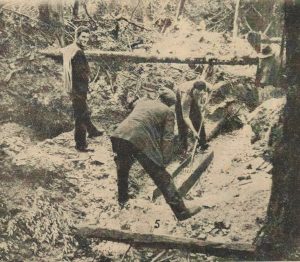
John Baptiste (back to camera) working a sluice box for osmiridium at Keep it Dark Gully, Adamsfield. From the Tasmanian Mail, 11 November 1925, p.40.
Baptiste fared better with former policeman Percy Marsh. The pair was among the first diggers to follow the Stacey parties to the Adams River osmiridium field in June 1925. There the Adamsfield poet ‘Mulga Mick’ O’Reilly claimed to have found Baptiste doing so well that he employed two men: one carried his stores in from the Florentine River, while another ‘did his cooking, fetched his whisky from the sly-grog shop, and put him to bed at night’. One report was that he sold his claim for a bottle of rum.[16] Another had Baptiste making £8000 in three months with Marsh at Keep it Dark Gully—a sly reference to his skin colour?—before selling the claim for £350.[17] Again, however, rum may have been his downfall, as he claimed to have been robbed of £200 of his winnings in Hobart in December 1925.[18] Perhaps this is what caused him to default on payments for a block of land at Prince of Wales Bay, Glenorchy, in 1927, losing his investment.[19] By then Hooky Jack was back on the west coast, prospecting for tin in the Norfolk Range.[20]
Baptiste was done with the ossie, but what happened to his winnings? Was it a case of easy come, easy go in a string of Hobart pubs and brothels? And what happened to him? He was not the supposed 64-year-old Frenchman John Baptiste who died at Broken Hill in 1938.[21] Nor did he go missing on the Great Depression gold trail like Harry Bell Lasseter. Baptiste appears to have seen out his days prospecting for gold in Gippsland, a naturalised Australian who passed the age of 80.[22] Perhaps, like Sammy Dwyer, last man at the Nineteen Mile, he was content to scrape a subsistence living from an old field he knew well, cooking in a camp oven, growing a few vegetables and reading about a world that had passed him by.
[1] Henry Humphries, ‘Hooky Jack’; poem printed in the Advocate (Burnie), 31 March 1962, p.13.
[2] Henry Humphries, ‘Hooky Jack’; poem printed in the Advocate (Burnie), 31 March 1962, p.13.
[3] ‘Along the “ossy” track’, News (Hobart), 10 September 1925, p.1.
[4] ‘The Ethel mutiny and murders’, West Australian (Perth), 18 June 1900, p.2.
[5] See, for example, ‘Progress of the suburbs’, Sydney Morning Herald, 21 February 1914, p.8; and advert, Wagga Wagga Express, 15 August 1895, p.4.
[6] ‘A black bit of evidence’, Age (Melbourne), 18 October 1895, p.6.
[7] For Loughnan’s application for a monetary reward for his and Stanton’s discovery, see Edward Loughnan to Sir Elliott Lewis 23 December 1920, AB948/1/98 107B ‘Correspondence: osmiridium’ (Tasmanian Archive and Heritage Office, Hobart).
[8] ‘Feared that missing prospectors have been drowned’, Advocate, 17 June 1938, p.6.
[9] Henry Humphries, ‘Hooky Jack’; poem printed in the Advocate, 31 March 1962, p.13.
[10] ‘Waratah assault case’, Advocate, 19 November 1923, p.5.
[11] The Commonwealth of Australia electoral rolls for 1903, 1908 and 1909, State of Victoria, Division of Gippsland, roll of electors for the Subdivision of Omeo, described John Baptiste as a miner at Mitta Mitta. In 1911 his 30-acre gold lease on the Bemm River, Gippsland, was gazetted as abandoned (‘Gazette notifications’, Bairnsdale Advertiser and Tambo and Omeo Chronicle (Victoria), 2 September 1911, p.2). He was naturalised on 29 November 1911 at the age of 49, Victoria, Index to naturalisation certificates, no.12861, https://www.ancestry.com.au/interactive/60711/44441_346529-02210?pid=16656&backurl=http://search.ancestry.com.au/cgi-bin/sse.dll?_phsrc%3DAEX134%26_phstart%3DsuccessSource%26usePUBJs%3Dtrue%26gss%3Dangs-g%26new%3D1%26rank%3D1%26gsfn%3Djohn%26gsfn_x%3DNIC%26gsln%3Dbaptista%26gsln_x%3DNN%26msbdy%3D1865%26msbpn__ftp%3DPortugal%26msbpn%3D5184%26msypn__ftp%3DMelbourne,%2520Victoria,%2520Australia%26msypn%3D97862%26cpxt%3D1%26cp%3D2%26MSAV%3D1%26MSV%3D0%26uidh%3D2l5%26pcat%3DROOT_CATEGORY%26h%3D16656%26recoff%3D6%25208%26dbid%3D60711%26indiv%3D1%26ml_rpos%3D1&treeid=&personid=&hintid=&usePUB=true&_phsrc=AEX134&_phstart=successSource&usePUBJs=true, accessed 17 June 2017.
[12] Max Dyer, Hot air, bee stings & echoes: more bush yarns, the author, Bairnsdale (Victoria), 2006, pp.5 and 49.
[13] HB Silberberg to Bert Osborne, 8 May 1914, File 64-2-14, HB Selby & Co Papers (Noel Butlin Business Archive, Canberra); advert, Snowy River Mail (Orbost, Victoria), 11 December 1914, p.2.
[14] HB Selby to John Baptiste, 14 December 1916 and 19 January 1917, File 64-2-17, HB Selby & Co Papers (Noel Butlin Business Archive, Canberra);
[15] ‘Waratah assault case’, Advocate, 19 November 1923, p.5.
[16] MJ O’Reilly (‘Mulga Mick’), Bowyangs and boomerangs: reminiscences of 40 years’ prospecting in Australia and Tasmania, Hesperian, Carlisle (Western Australia), 1984 reprint, p.160.
[17] ‘The sifting out’, Examiner, 25 December 1925, p.5; ‘Adams River osmiridium field’, News (Hobart), 9 September 1925, p.1.
[18] ‘The morning after’, Daily News (Perth), 30 December 1925, p.1.
[19] Advert, Mercury, 16 November 1927, p.12.
[20] ‘Reported missing: prospector returns to camp, Mercury, 29 July 1927, p.6.
[21] ‘Wilcannia-Forbes Diocese’, Catholic Press, 22 September 1937, p.27.
[22] The Commonwealth of Australia electoral rolls for 1931, 1934 and 1943, State of Victoria, Division of Gippsland, roll of electors for the Subdivision of Leongatha, described John A Baptista as a prospector at Walkerville, via Fish Creek.
by Nic Haygarth | 04/04/17 | Tasmanian high country history
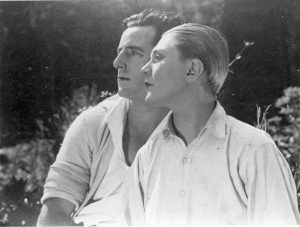
More like a manicurist than a miner: Louise Lovely as Dick Fleetwood (right) and Gordon Collingridge as Salarno (left) in the 1925 movie Jewelled nights. JH Robinson photo courtesy of the late Nancy Gillard.
In November 1922 Nineteen Mile Creek osmiridium digger Charlie Prouse slapped a record-breaking lump of metal on the bar of Bischoff Hotel in Waratah, the nearest town. Prouse’s sale of his father Tom’s all-time-Tasmanian-record nugget probably brought them much needed, instant cash—and paid off their tab.
Metal as frontier currency fed into the old gold rush romance of a roistering wild west. This image and the rugged landscape appealed to Hobart romance writer Marie Bjelke Petersen, who found ‘nuggets’ of a different kind—human ones—on the ‘ossie’ fields. Some of her nuggets were female. In her best-selling 1923 novel Jewelled nights, gender bending on the Savage River osmiridium field enabled a Melbourne society belle to evade a marriage of inconvenience.[1] The runaway bride, Elaine Fleetwood, hid out on the Tasmanian frontier in the guise of a man, Dick Fleetwood. When, eventually, her clever disguise of slicked-down hair and dungarees failed her, the heroine submitted to fellow digger Larry Salarno, nature’s true gentleman. They married in nature’s own cathedral, a beautiful button grass area known as Long Plain, which today, unfortunately, is not quite so romantic, being occupied by the settling ponds of the Savage River iron ore mine.[2]
Bjelke Petersen was already a best-selling author when she wrote Jewelled nights. The irony of gushing heterosexual romance peddled by an unmarried virgin with a live-in female companion seems to have been lost on swooning young female fans across the English-speaking world. In the course of her research, Bjelke Petersen had established a reputation for venturing into the masculine realm at the frontier of civilisation. In 1921 she and her companion Sylvia Mills took a grand tour of the western mining fields. Based at the Whyte River Hotel, and with Vic Whyman as their guide, they had many thrilling experiences while visiting the Rio Tinto (Savage River bridge), Burnt Spur and Nineteen Mile osmiridium fields.[3] Bjelke Petersen gushed that
‘we often wondered if we should ever return. The precipitous mountain tracks were so dangerous, snakes were most numerous, we had to drive with horses that had never been in harness before, and were out in thunderous storms of tropical severity …’
She claimed that on one occasion, only the intervention of Joe O’Connor, manager of the Jasper mine, saved the pair from being backed off the edge of a mountain track by a frightened horse during a storm. While crossing Long Plain en route to Burnt Spur, the author was struck by
‘the most gorgeous forests of giant myrtles and sassafras, the densest in the world, with alluring fern gullies and trickling streams, all along the five miles of awe-inspiring grandeur till the river was reached, deep down in the heart of a huge ravine’.[4]
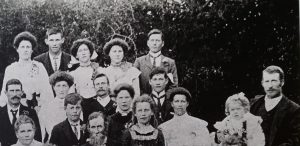
Members of the Humphries family, Rendelsham, South Australia, 1905, including four future osmiridium diggers: the amateur poet Henry (back row, second from left), Allan (standing, extreme left), Bob (standing, extreme right) and Frances Hazel (aka Frank, the girl in the centre of the front row). Photo courtesy of the late Olive Plapp.
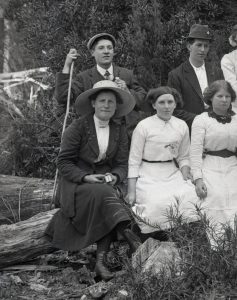
Frances Hazel Humphries (in wide-brimmed hat) as a young woman. Crop from a Stephen Hooker photo courtesy of Phil Rolton.
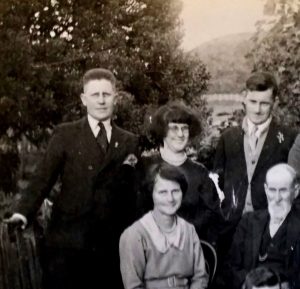
Frank Humphries as a man (standing, at left), 1932. Crop from a photo courtesy of the late Olive Plapp.
At Burnt Spur, where her novel was later set, she met one of the osmiridium field’s two women, Eva Tudor. A local legend, however, preferred another local, Frances Hazel Humphries, as the model for Bjelke Petersen’s heroine Elaine Fleetwood.[5] Humphries, born a girl and known by her middle name Hazel, eventually took a male name, wore men’s clothes, and performed traditionally male labour—including a stint on the Mount Stewart osmiridium field. Former Waratah resident Eric Thomas believed that as a young woman Hazel fell pregnant and, after having the baby at a Salvation Army maternity home, returned to Waratah as Frank Humphries, with hair brushed back and wearing a felt hat. He milked cows for the Penney family and delivered the milk by cart around Waratah. Thomas remembered that after a short stint working at Mrs Delphin’s ‘eat up shop’ in Waratah, Frank tried his hand at the osmiridium fields. It was there that Thomas met him while packing supplies for Tom Cumming and Ray Whyman.[6] In his book Taking you back down the track, Humphries’ contemporary Harry Reginald Paine recalled his ability with horses, cross-cut saw and pick and shovel.[7] In the years 1926‒31 Frank Humphries was an employee of the Burnie Dairy Co.[8] Later he became a Burnie shopkeeper, and ‘married’ a female partner with whom he relocated to Melbourne.
There were female diggers and miners’ partners on several osmiridium fields. Frank–Hazel’s story is more unusual yet, but there is no evidence of it being the inspiration for Marie Bjelke Petersen’s romance. It is unknown whether Bjelke Petersen even met Humphries. Yet one can imagine the novelist admiring a woman who refused, as Bjelke Petersen did herself, to conform to a prescribed gender role. Career, social standing and much wider scrutiny would have prevented Bjelke Petersen venturing beyond this role in Hobart—but the western mining fields, as the author found, offered a non-conformist almost anonymity. Perhaps that discovery was the real inspiration for Jewelled nights.
[1] Marie Bjelke Petersen, Jewelled nights, Hutchinson & Co, London, 1923.
[2] Button grass (Gymnoschoenus sphaerocephalus) is a native Tasmanian sedgeland plant so named because of its button-like seed heads.
[3] Vic Whyman claimed he was the singing coach driver who was immortalised in Jewelled nights. See Maggie Weidenhofer, ‘Marie Bjelke Petersen: forgotten writer of passion’, This Australia, Spring 1983, p.42.
[4] ‘In the wilds of the west’, Advocate, 29 January 1921, p.3.
[5] See Harry Reginald Paine, Taking you back down the track … is about Waratah in the early days, Somerset, 1994, p.98.
[6] Letter from Eric Thomas, undated, 1990s. The 1919 and 1924 assessment rolls show H Humphries occupying a cottage in North Street owned by HP McCreery (Tasmanian Government Gazette, 10 November 1919, p.2122; and 24 November 1924, p.2280).
[7] Harry Reginald Paine, Taking you back down the track … is about Waratah in the early days, Somerset, 1994, p.98.
[8] ’15 witnesses examined yesterday’, Advocate, 2 September 1931, p.6.
by Nic Haygarth | 13/02/17 | Circular Head history, Tasmanian high country history
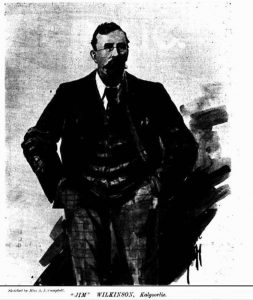
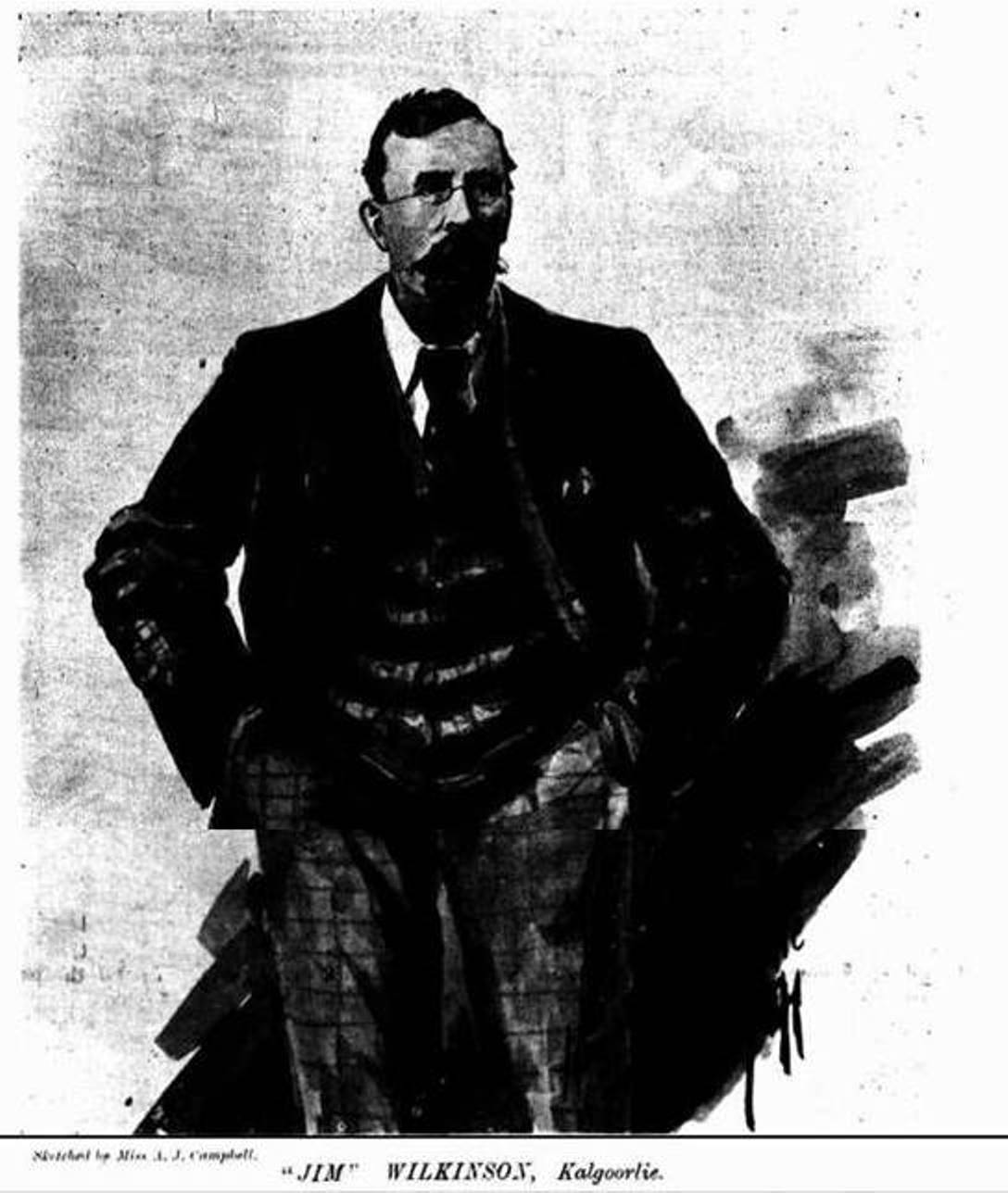
‘Big Jim’ Wilkinson, sketched by Miss AJ Campbell at Kalgoorlie in 1898. From Critic (Adelaide), 26 March 1898, p.5
A heartbreaking dedication is inscribed on a ceramic vase on one of the four marked graves in the Balfour Cemetery:
To Jim
good night love
may the night be short
that parts we two
Alma
Big Jim Wilkinson stood almost 200 cm tall—6 foot 5 inches in the old measure. He was proof that even remote Tasmanian mining fields attracted not just local prospectors, labourers, miners, engine drivers and other skilled workers, but international adventurers, men who flitted between gold rushes and boom towns, revelling in the lifestyle, but who eventually settled into the more stable support industries that underpinned every mining field. Wilkinson, who supposedly counted Australia’s first prime minister, Edmund Barton, and the poet, Adam Lindsay Gordon, as friends, had been an imposing figure on the Kalgoorlie goldfield, being ‘a big power with the miners … He is one of the most popular men in Kalgoorlie, and deservedly so. He has a head like a Roman senator…’[1] He hadn’t quite made it into the Australian Senate, being defeated in two campaigns in Western Australia. He was also said to have made ‘a prodigious impression’ in Gormanston, ‘with his Uncle Sam beard, his diamonds, his earrings, and his accent which was very good American for a Victorian native!’[2] He had discovered gold on the Murchison field, kept livery stables and attained legendary status as a coach driver in the early days of the Silverton-Broken Hill silver field by keeping his passengers—or his horses, if he was carrying only freight—awake through the night with recitations of Gordon’s verses.[3] He had been a pearler, a guano dealer in south-east Asia, a race handicapper and a hotelier.[4]
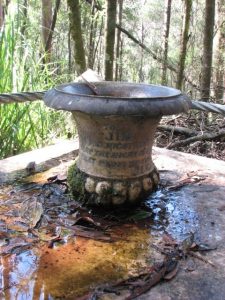
Alma’s inscription on Jim’s grave at Balfour.
Photo by Nic Haygarth.
However, none of that counted for anything at Balfour, where Wilkinson achieved another distinction entirely—he was the first interment in the cemetery, in January 1910, after only one month in town. He had come to Balfour to run a hotel for his brother-in-law, the ubiquitous jack-of-all-trades Frank Gaffney. Wilkinson arrived as a diabetic, in a shanty town that had no resident doctor.[5] Nor was there a minister to officiate at his grave. Like typhoid victims Haywood and Tom Shepherd before him, he died when there was no tramway from Temma. His grave relics—with their emphatic tale of loss and devotion—must have been hauled in from Temma by horsepower at least a year after his death. For more than a century, Big Jim Wilkinson, bright star of the boom-time, has rested in obscurity on one of Australia’s most obscure mining fields, leaving us to ponder the levelling power of death and the burning question—who was Alma?
*With thanks to Val Fleming.
[1] ‘Language freaks’, Critic (Adelaide), 26 March 1898, p.5.
[2] ‘Gormanston notes’, Zeehan and Dundas Herald, 27 October 1903, p.4.
[3] See, for example, Randolph Bedford, Naught to thirty three, Currawong Press, Sydney, 1944, pp.98–100.
[4] See, for example, ‘Death of Mr JJ Wilkinson’, Kalgoorlie Western Argus, 1 November 1910, p.15.
[5] ‘Resident doctor’, Examiner, 10 January 1910, p.5.
by Nic Haygarth | 31/01/17 | Tasmanian high country history
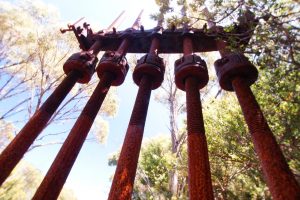
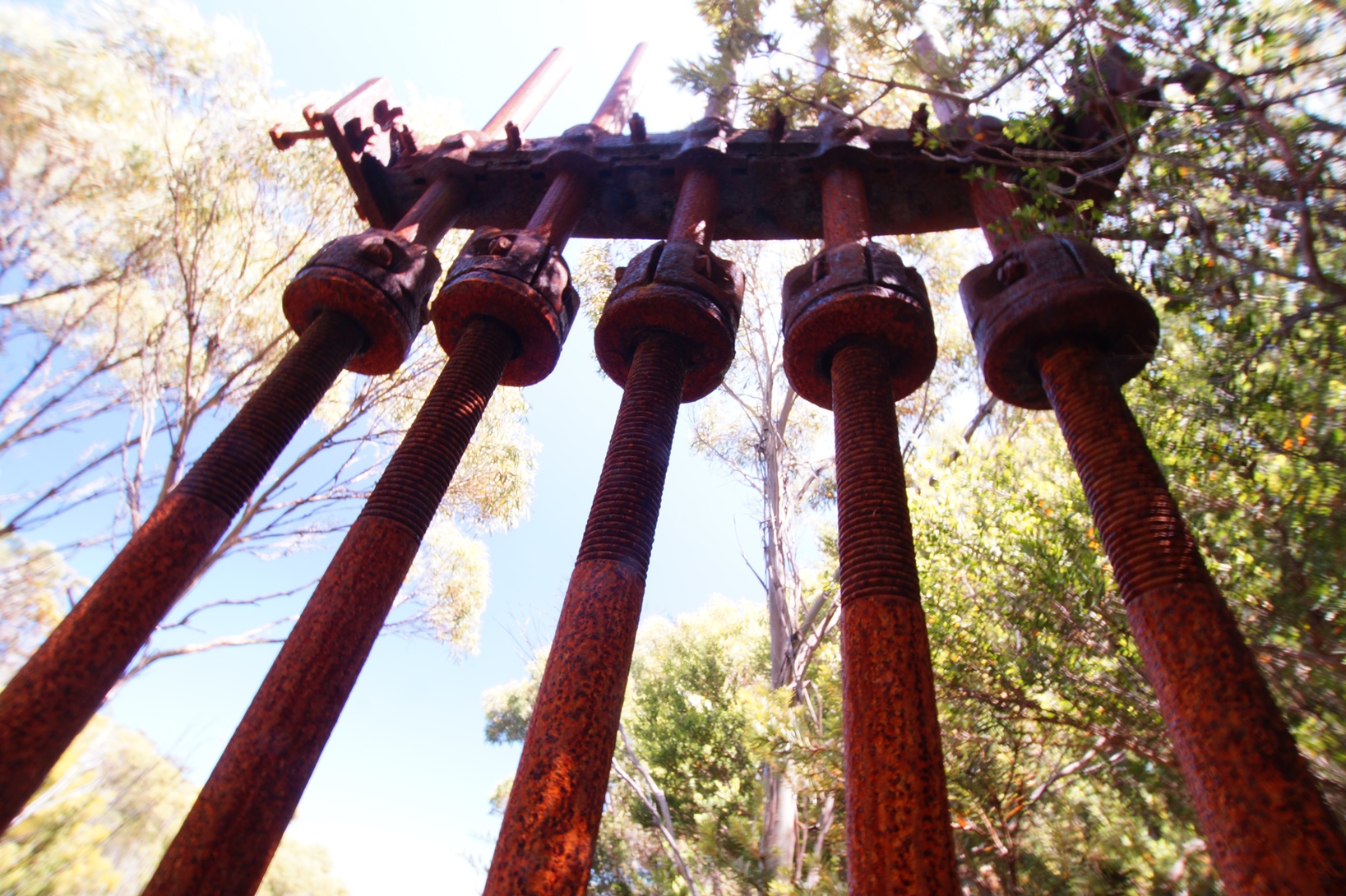
Five-head battery at the Carn Brea tin mine, the only battery remaining in situ on the Heemskirk field. Nic Haygarth photo.
A lode tin mining boom in western Tasmania followed Inspector of Mines Gustav Thureau’s poorly considered 1881 claim that ‘the Mount Heemskirk and Mount Agnew tin deposits appear to be … of grave importance to the Colony at large’ and that ‘their permanence has already been proved …’[1] As Thureau discovered, when he arrived there unwisely in winter, the difficulties of working the remote field were enormous. It was an exposed coastal area characterised by cold winters, driving rain, dense vegetation and steep terrain. There were no roads, and no useful supply routes. The closest thing to a port was Trial Harbour, a shallow inlet open to the winds which crashed the Southern Ocean onto the coast.
Tasmanians subscribed to the idea that Cornish miners were the model of practical, economical tin mining. Trained-on-the-job Cornish miners were in great demand at Heemskirk, and they encouraged their excited employers with ludicrous allusions to their homeland. In August 1881, for example, one of the Heemskirk mine managers, Robert Hope Carlisle, was said to be trying to trace the continuation of the famous Dolcoath tin lode from Cornwall across the oceans to Heemskirk.[2] However, their assertions that Tasmanian tin lodes would ‘live down’ like Cornish ones proved disastrous on a field where the deposits were actually small and inconsistent. Ironically, the fortunes of one novice Cornish miner, Josiah Thomas (JT) Rabling, in Tasmania suggest that Heemskirk was indeed the ‘Cornwall of the antipodes’, that is, it proved as hard to make a living on the Tasmanian tin fields as it was in the depressed Cornwall he had escaped.
Josiah Thomas Rabling
Rabling was the Cornishman chosen to work the Carn Brea Tin Mine at Heemskirk. He was born into a well-known Camborne, Cornwall mining family in about 1843, the fourth of eight children.[3] As the nephew of William Rabling senior, who had made his name and fortune in the Mexican silver mines, and also the nephew of Charles Thomas, manager of the famous Dolcoath Mine at Camborne, he was born with a mining pedigree.[4] Josiah’s father, Henry Rabling, mined in Mexico, but does not appear to have succeeded there, leaving effects to the value of less than £450 when he died in 1875.[5] The fact that Josiah Rabling was in the workforce at the age of seventeen suggests that his mining education was on the job, rather than in the class room—and there was no Camborne School of Mines until 1888. Rabling grew up at a time when England lagged behind countries like Germany and the United States of America in not having a mining academy system.[6] In 1861 young Rabling was a smith, in 1871 he was a mining clerk at Camborne, near the Great Flat Lode of tin mines and the Dolcoath Mine, which produced copper and tin for centuries.[7]
However, the crash of the copper price in the second half of the nineteenth century, the effect of the cost book system and Cornwall’s lack of a coal resource on its industrial economy, and additional failures in agriculture and fishing placed great stress on Cornish mine workers and labouring families. By 1873 the tin price was also falling, and 132 Cornish tin mines closed over the next three years.[8]
It is likely that the death of Rabling’s father in 1875 and the downturn in the local mining industry necessitated a search for work elsewhere. Competition to Cornwall from the Australian tin mines had begun with almost simultaneous discoveries on the New England tableland in northern New South Wales and at Mount Bischoff in Tasmania. Rabling arrived in Tasmania on the Argyle in 1876, perhaps being sent by British capitalists interested in Tasmanian mines.[9] During 1877 and 1878 he secured commissions to report on various mines, but by the following year was down on his luck. In August 1879, after making a little money by paling splitting, he forged a signature on a cheque which he presented in the town of Waratah (Mount Bischoff) to pay a small cartage fee incurred by a friend. He pleaded guilty to a crime committed in ‘such a childish manner’, according to a reporter for the Mercury (Hobart) newspaper, ‘with so little gain attached to it that it really looked as if he wanted to get into prison’.[10] Despite this being a first offence, Rabling was sentenced to twelve months’ imprisonment.[11] The effects of this experience are unknown, but one subsequent effort to make a living in Tasmania also landed him in trouble. In July 1881, along with three other men, he was tried in the Supreme Court, Hobart, on a charge of unlawfully conspiring to defraud Peter McIntyre to the tune of £400 by salting the Band of Hope Mine. Rabling and one other were found not guilty.[12]
Despite these events, such was the allure of the Cornish ‘practical miner’ that only a month later Rabling was one of two men engaged by the British Lion Prospecting Association to prospect on the Heemskirk tin field.[13] The Heemskirk tin deposits, like those of Mount Bischoff, occurred in granite—and who knew more about working tin in granite than Cornishmen?
A tributary of Granite Creek was the site of one of three Heemskirk sections leased by Rabling. The creek, he said, would be sufficient to drive machinery.[14] Even today the site, within a several hundred metres of the sea, is a remote one, three hours’ walk from shack settlements at Trial Harbour and Granville Harbour. It is hard to imagine what a young man from Camborne made of tent life exposed to the roaring surf of the Southern Ocean.
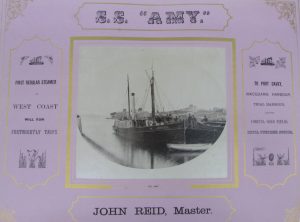
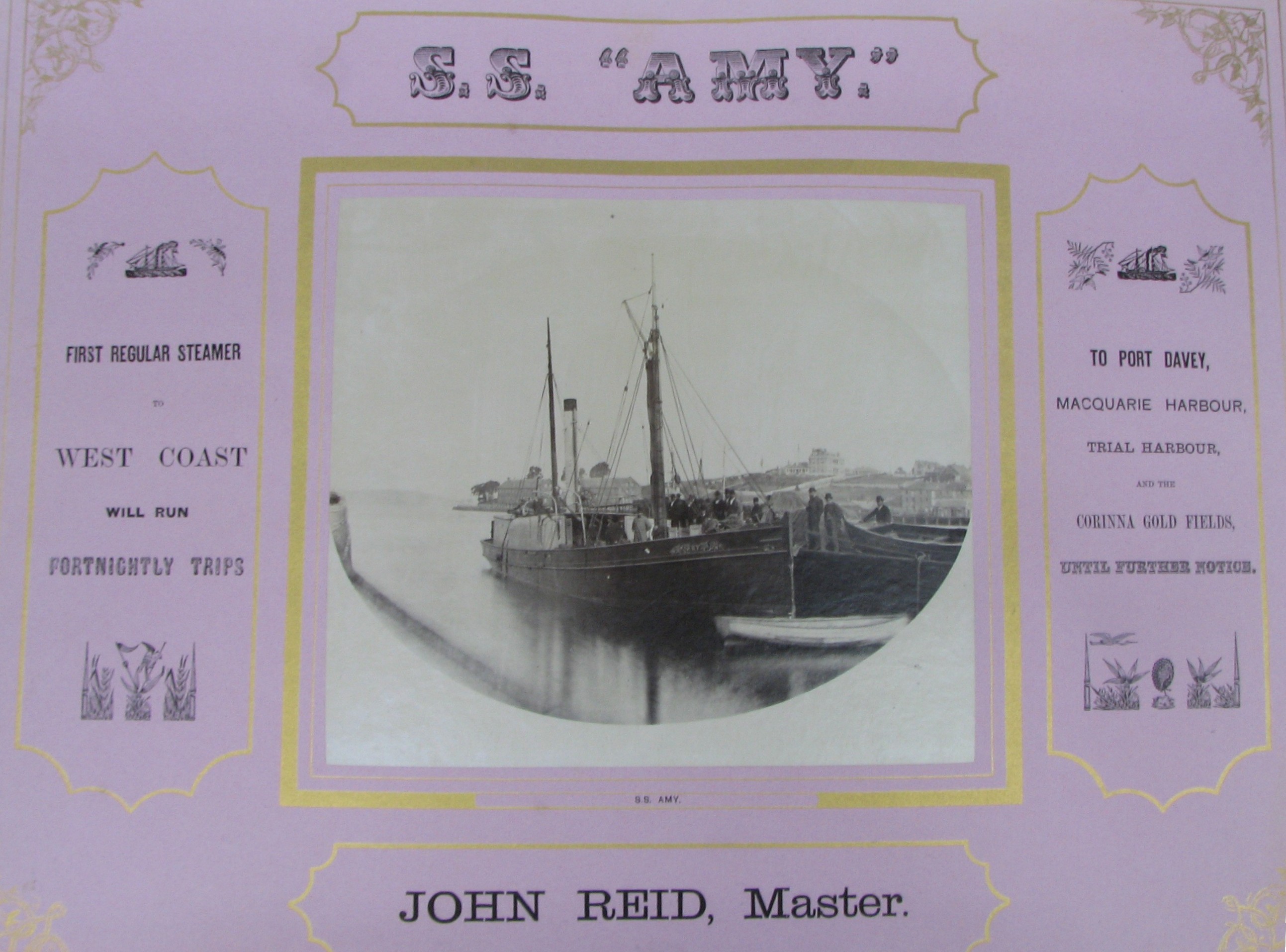
The ss Amy at dock.
Anson Brothers photo courtesy of the Tasmanian Archive and Heritage Office.
Even being delivered to the Heemskirk field was an endurance test. Rabling first ventured westward out of Launceston on the small steamer the ss Amy, which had begun to unload if not dock at Boat (later Trial) Harbour.[15] Seventeen passengers plus stores for the Pieman River goldfield were crammed aboard the tiny vessel, which took on further stores at Latrobe on the Mersey River during a five-day stopover. When the Amy got underway again, overloading had made it so unsteady that the bulk of the cargo had to be put ashore at the Mersey heads. Another layover occurred at the port of Stanley, in the far north-west, this time for bad weather. On the seventh day out of Launceston the steamer put in at the remote sheep and cattle station of Woolnorth, on the north-western tip, again delayed by buffeting winds, the passengers having enough time ashore to go rabbiting, inspect the bones of a stranded whale and hold a meeting in which they established their own west coast prospecting association! Reaching the Pieman River heads ten days out of Launceston brought good news —the dreaded bar was passable, for the first time in many days. So many vessels had come to grief on the Pieman River bar that a successful crossing was invariably met with an address of thanks to the captain and his chief officer and a hearty round of cheers. Passengers had time to develop an opinion on nearby gold workings before re-embarking for Heemskirk.[16]
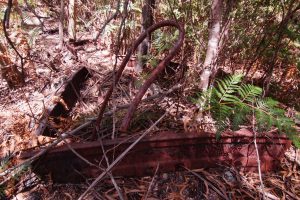
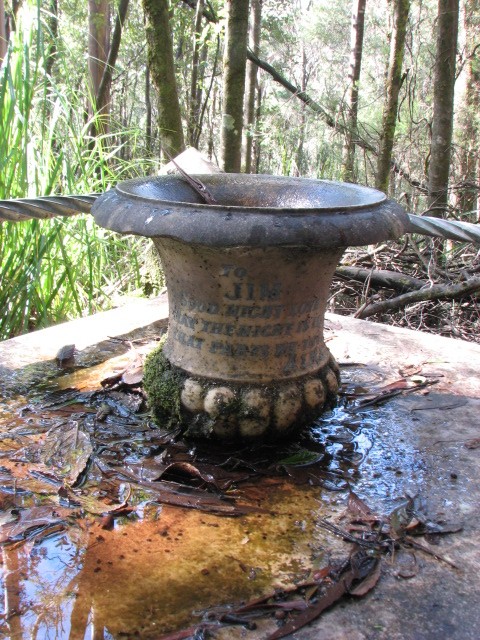
Sections of the metalwork of the overshot waterwheel remain on site next to the Carn Brea wheelpit today. Nic Haygarth photo.
Developing the Carn Brea Tin Mine
At the inaugural meeting of the Carn Brea Tin Mining Company, held in Hobart in January 1883, Rabling was appointed mine manager and promptly adjourned to the west coast with eight assistants. While publicly, at least, Rabling made no grandiose comparisons with the Cornish tin field, he did name the mine Carn Brea, after the hill that stands over his home town, Camborne, in Cornwall, perhaps a reflection of homesickness as well as an assurance of worth to cheer the shareholders. In February 1883 Carn Brea shareholders authorised a loan to pay for a battery and a 24-foot iron overshot waterwheel manufactured at WH Knight’s Phoenix Foundry in Launceston.[17] A road had to be built to North Heemskirk before the equipment was delivered by steamer at the dangerously exposed port of Trial Harbour.[18] However, when the machinery came to be hauled up the road by horse team the carters ran out of horse feed, causing further delay.[19] When visiting the Carn Brea Mine, the Mercury newspaper’s ‘special’ reporter Theophilus Jones was only able to inspect the stone cutting and wheel pit prepared for its reception, Rabling’s 84-foot drive and 20-foot winze and a lode said to be four to five feet wide. He was reassured by the manager serving him steaming Royal Blend tea, preserved meat and ‘excellent’ bread and butter. Furthermore, Rabling had
‘pitched his camp in a snug corner formed by the junction of two banks above a small creek. He has not wasted the shareholders’ money by erecting large and substantial houses, stable and blacksmith’s shops, with a store and a post office thrown into the bargain, but has contented himself with putting up tents, and cutting chimneys and fireplaces in the bank’. [20]
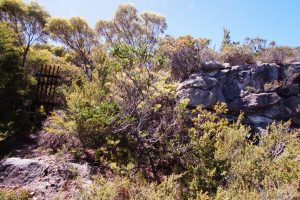
The battery and a rock face that appears to have been cut away to accommodate a work site, Carn Brea tin mine. Nic Haygarth photo.
The most settled weather in western Tasmania is in February and March, but many water-powered mines found it too dry to operate in those months. April, May and the winter and spring months would normally provide abundant rainfall, but the west coast weather would then be bracing, to say the least. Rabling would have had no choice but to stay put and do his shareholders’ bidding by preparing the claim for crushing as soon as possible, much of his time being spent huddled in a sturdy tent.
The fatal first crushing
The first half-yearly meeting of the Carn Brea Tin Mining Company in July 1883 glowed with a happy anticipation. Neither the £1800 advance on machinery, nor the six calls on shares, had disturbed the shareholders’ equanimity. Stone assaying a payable 7.5 to 14% had been paddocked awaiting the crusher, demonstrating the admirable ‘energy and skill’ of the company’s mining manager.[21]
The Carn Brea was one of nine mines on the Heemskirk field to erect a battery during the boom period. In all, 75 or 80 head of stampers were raised.[22] By October 1883 Thomas Williams was ready to crush at the Orient tin mine.[23] The Cliff and Carn Brea were almost ready to crush, the Montagu and the Cumberland were erecting machinery and mine manager George Lightly of the West Cumberland was preparing to receive machinery.[24]
However, the failure of the Orient crushing one month later threw ‘a great damper … on lode tin mining at Mount Heemskirk …’[25] Confidence in the field evaporated. The Carn Brea Tin Mining Company kept going until at its second half-yearly meeting in March 1884 it was revealed that, although assay results from the first shipment of 30 bags of crushed ore were not yet available, directors regarded mining operations as a failure. Not surprisingly, expenditure due to work delays and heavy freight costs had far exceeded Rabling’s estimates. Work had been suspended, and many shares in the company had been forfeited. One of the directors, Grubb, condemned Rabling’s management, and several disputed that he had secured any tin from the mine. Eventually, shareholders voted to accept Rabling’s offer to take the mine on tribute (that is, working the company’s lease for a percentage of the value of ore won, so at no cost to the shareholders), the unknown value of the 30 bags of tin being taken as part payment for the wages the company owed him.[26] All work seems to have been abandoned soon after. No further substantial work appears to have taken place at the Carn Brea Mine.
Although Trial Harbour would enjoy a brief resurgence as the port for the Zeehan–Dundas silver-lead field, the Heemskirk tin field would never fulfil early expectations. Former Peripatetic Tin Mine manager Con Curtain estimated that at least £100,000 were spent at Heemskirk 1880–84 for a return of about 70 to 100 tons of dressed tin.[27] By 1962 total production on the field had not progressed substantially, amounting to a mere 668 tons of metallic tin.[28]
[1] Gustav Thureau, West coast, Legislative Council Paper 77/1882, p. 27.
[2] ‘Mt Heemskirk’, Mercury (Hobart), 5 October 1881, supplement, p. 1.
[3] Census for England 1851 and 1861.
[4] ‘Miss Eliza Rabling’, Cornishman, 19 January 1889, p. 2; Sharron P Schwartz, Mining a shared heritage: Mexico’s ‘Little Cornwall’, Cornish–Mexican Cultural Society, England, 2011, pp. 51–52.
[5] England and Wales Probate Calendar, 1858–1966.
[6] Rod Home, ‘Science as a German export to nineteenth century Australia’, Working Papers in Australian Studies, no. 104, London, 1995, pp. 7–11, 17.
[7] Census for England 1861 and 1871.
[8] Philip Payton, Cornwall: a history, pp. 215–20; Allen Buckley, The story of mining in Cornwall, p. 140.
[9] ‘Gold news’, Launceston Examiner, 3 March 1877, p. 5.
[10] ‘Our Launceston letter’, Mercury, 4 October 1879, p. 3.
[11] Conduct record, CON37/1/11, p. 6063 (Tasmanian Archive and Heritage Office, Hobart [hereafter TAHO]).
[12] ‘Second Court’, Mercury, 28 July 1881, p. 3.
[13] ‘Mining’, Mercury, 30 August 1881, p. 3; ‘Tin’, Launceston Examiner, 31 August 1881, p. 3.
[14] ‘Mining’, Mercury, 27 April 1882, p. 3.
[15] ‘Tin’, Launceston Examiner, 31 August 1881, p. 3.
[16] ‘The west coast goldfields’, Mercury, 17 September 1881, p. 2.
[17] ‘Heemskirk’, Mercury, 23 October 1883, p. 3; ‘Tin’, Launceston Examiner, 9 March 1883, p. 3.
[18] ‘Mount Heemskirk’, Mercury, 8 May 1883, p. 3.
[19] ‘Managers’ reports’, Mercury, 30 June 1883, p. 2.
[20] ‘Our Special Reporter’ (Theophilus Jones), ‘The west coast tin mines’, Mercury, 31 May 1883, p. 3.
[21] ‘Mining’, Mercury, 1 August 1883, p. 3.
[22] According to Con Curtain and LJ Smith, companies which installed batteries included the Carn Brae (JT Rabling; 10 heads, from .H Knight’s Phoenix Foundry, Launceston), Orient (John Williams; Thomas S Williams; 10, Salisbury Foundry, Launceston), Cliff (John Hancock; William Williams; W Thomas; PT Young; Edward Perrow, 5), the West Cumberland (George Lightly; 5), the Wakefield (5), Cumberland (AB Gallacher; 10), the Montagu (Alex Ingleton; 15), the Victorian-registered Cornwall Tin Mining Co (Mark Gardiner; 10, WH Knight), and Peripatetic (Con Curtain; 10). Companies which did not install machinery included the Montagu Extended (Robert Hope Carlisle), Prince George (John Addis), St Clair (James Henry Nance), Champion (WG Hensley), Mount Heemskirk and Agnew (John Greenwood), Heemskirk River (Edwin Tremethick) and the St Dizier (Nicholas St Dizier). The Empress Victoria (Thomas Fowler) had a steam hoisting plant but no treatment plant. See Con Henry Curtain, ‘Old times: Heemskirk mines and mining’, Examiner, 27 February 1928, p. 5; and LJ Smith, ‘South Heemskirk tin mine’, Advocate, 11 August 1928, p. 14. Curtain claimed there were 75 heads of stampers on the field, but Smith’s list of batteries added up to 80 heads.
[23] Con Henry Curtain, ‘Old Times: Heemskirk Mines and Mining’. There is a five-head battery at the Carn Brea mine today.
[24] ‘Heemskirk’, Mercury, 23 October 1883, p. 3.
[25] Editorial review of 1883, Launceston Examiner, 1 January 1884, p. 2.
[26] ‘Mining’, Mercury, 3 April 1884, p. 3.
[27] Con Henry Curtain, ‘Old times: Heemskirk mines and mining’.
[28] AH Blissett, Geological survey explanatory report, One Mile Geological Map Series, Zeehan, Department of Mines, Hobart, 1962, p. 112.